
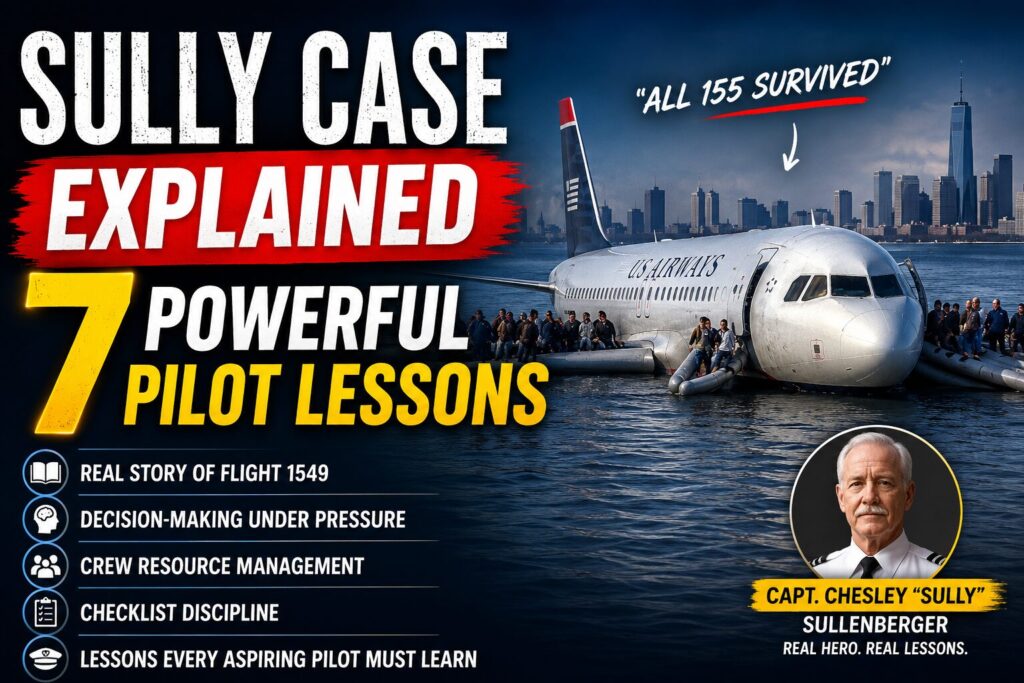
Sully Case Explained: 7 Powerful Pilot Lessons
Sully Case Explained refers to the emergency ditching of US Airways Flight 1549 into the Hudson River after a dual-engine bird strike disabled both engines of an Airbus A320 on 15 January 2009. Captain Chesley “Sully” Sullenberger safely landed the aircraft on water, and all 155 passengers and crew survived.
The Sully case is now considered one of the greatest aviation safety case studies ever because it demonstrates emergency decision-making, Crew Resource Management (CRM), checklist discipline, and pilot training under extreme pressure.
Table of Contents
- What Was the Sully Case?
- What Happened During Flight 1549?
- Why Did Both Engines Fail?
- Could the Aircraft Have Returned?
- 7 Powerful Pilot Lessons
- How to Become a Pilot in India
- Eligibility Criteria
- Pilot Training Process
- CPL vs Cadet Program
- Cost of Pilot Training
- Career Opportunities
- Pilot Salary in India
- Common Mistakes
- FAQs
What Was the Sully Case?
The Sully case involved US Airways Flight 1549, an Airbus A320 that suffered a dual-engine failure shortly after takeoff from LaGuardia Airport in New York.
Captain Sully made the critical decision to ditch the aircraft into the Hudson River after determining that reaching a runway safely was unlikely.
| Detail | Information |
|---|---|
| Flight Number | US Airways Flight 1549 |
| Aircraft | Airbus A320 |
| Date | 15 January 2009 |
| Main Cause | Bird Strike |
| Passengers & Crew | 155 |
| Fatalities | 0 |
| Landing Location | Hudson River |
Read the official investigation report by the National Transportation Safety Board (NTSB) .
What Happened During Flight 1549?
Flight 1549 departed normally before colliding with a flock of Canada geese at approximately 2,800 feet.
Within seconds, both engines lost thrust, creating an extremely rare aviation emergency.
Timeline of Events
- Aircraft departs LaGuardia Airport
- Bird strike occurs around 2 minutes later
- Both engines fail
- Pilots attempt engine restart
- ATC offers runway options
- Sully evaluates altitude and distance
- Aircraft ditches into Hudson River
- All passengers survive
The Sully case is now used worldwide in airline and CPL training programs to teach aviation decision-making.
Why Did Both Engines Fail?
The Airbus A320 ingested multiple large Canada geese into both engines.
The bird strike caused severe internal engine damage that resulted in near-total thrust loss.
Lesser-Known Technical Facts
- Most commercial engines are certified for smaller bird strikes
- Flight 1549 experienced multiple large bird ingestion
- The impact exceeded standard certification assumptions
- The event changed global discussions about bird strike safety
Learn more about aviation safety regulations through the DGCA official website .
Could the Aircraft Have Returned to the Airport?
No. According to the final NTSB investigation, ditching in the Hudson River offered the highest probability of survival.
Although simulator tests later showed successful airport returns, those simulations assumed unrealistically immediate pilot reactions.
Important Human Factors
- Shock and recognition time
- Checklist execution
- Communication delays
- Stress management
- Rapid decision-making
What Are the 7 Powerful Pilot Lessons from the Sully Case?
The Sully case remains one of aviation’s greatest training examples because it demonstrates how preparation, communication, and decision-making affect survival outcomes.
Lesson 1: Aviate First, Troubleshoot Second
Pilots must maintain aircraft control before solving technical problems.
- Aircraft control is always the first priority
- Stable flight creates time
- Panic leads to poor decisions
Lesson 2: Decision-Making Under Pressure Saves Lives
Captain Sully had only seconds to evaluate available options.
| Skill | Importance |
|---|---|
| Situational Awareness | Understanding available options |
| Risk Assessment | Selecting safest outcome |
| Prioritization | Managing workload |
| Time Management | Acting before options disappear |
Lesson 3: Crew Resource Management (CRM) Is Critical
The successful outcome was the result of effective teamwork between Captain Sully and First Officer Jeff Skiles.
- Clear communication matters
- Task sharing reduces workload
- Team coordination improves survival
- Trust improves cockpit efficiency
Lesson 4: Training Builds Automatic Reactions
Emergency performance depends heavily on repetitive training and simulator practice.
- Engine failures
- Emergency landings
- Hydraulic failures
- Rapid decompression
- Checklist execution
Students preparing for airline careers can explore Commercial Pilot License (CPL) training at Airline Prep School (ALPS).
Lesson 5: Checklist Discipline Matters
The Sully case showed that checklist management is essential during emergencies.
However, pilots may not always have enough time to complete every checklist item.
- Know aircraft systems deeply
- Prioritize critical actions
- Avoid checklist fixation
- Adapt under pressure
Lesson 6: Communication Can Reduce Chaos
Communication between the cockpit, ATC, and cabin crew remained calm throughout the emergency.
- Use clear phraseology
- Keep instructions short
- Avoid unnecessary radio calls
- Maintain calm tone
Lesson 7: Experience and Preparation Matter More Than Luck
The Sully case is often called a miracle, but preparation played the biggest role.
- Discipline
- Consistency
- Technical knowledge
- Emotional control
- Repetitive practice
How to Become a Pilot in India
To become a commercial pilot in India, students must complete DGCA-approved training and obtain a Commercial Pilot License (CPL).
Basic Pathway
- Complete 10+2 with Physics and Mathematics
- Obtain DGCA Class 2 Medical
- Join DGCA ground classes
- Clear DGCA exams
- Complete flying hours
- Obtain CPL
- Apply to airlines
Explore detailed pilot training guidance from ALPS.
What Are the Eligibility Criteria for CPL?
| Requirement | Criteria |
|---|---|
| Minimum Age | 17 Years |
| Education | 10+2 with Physics & Maths |
| Medical | DGCA Class 1 & 2 |
| Language | English proficiency |
What Is the Step-by-Step Pilot Training Process?
Step 1: Complete Class 12
Physics and Mathematics are mandatory.
Step 2: Obtain DGCA Medical
Students must clear Class 2 and Class 1 medicals.
Step 3: Begin Ground School
- Navigation
- Meteorology
- Air Regulations
- Technical General
Step 4: Start Flying Training
Students complete DGCA-required flying hours.
Step 5: Clear DGCA Exams
Theory exams must be passed successfully.
Step 6: Obtain CPL
DGCA issues the Commercial Pilot License.
CPL vs Cadet Program: Which Is Better?
| Feature | CPL Route | Cadet Program |
|---|---|---|
| Flexibility | High | Limited |
| Cost | Moderate | Higher |
| Airline Tie-Up | Optional | Usually Included |
| Entry Difficulty | Easier | Competitive |
Learn more about pilot cadet preparation programs .
What Is the Cost of Pilot Training in India?
Pilot training in India generally costs between ₹45 lakh and ₹70 lakh.
| Component | Estimated Cost |
|---|---|
| Ground School | ₹2–5 lakh |
| Flying Training | ₹35–55 lakh |
| DGCA Exams | ₹50,000+ |
| Type Rating | ₹20–35 lakh |
What Career Opportunities Exist After CPL?
- Airline First Officer
- Charter Pilot
- Cargo Pilot
- Corporate Aviation Pilot
- Flight Instructor
- Government Aviation Services
What Is the Salary of a Pilot in India?
| Position | Salary Range |
|---|---|
| Cadet Trainee | ₹50,000–₹1.5 lakh/month |
| First Officer | ₹2–6 lakh/month |
| Captain | ₹8–15 lakh+/month |
What Common Mistakes Should Aspiring Pilots Avoid?
- Ignoring medical fitness
- Choosing low-quality flying schools
- Weak DGCA exam preparation
- Poor communication skills
- Lack of financial planning
FAQs About the Sully Case Explained
What caused the Sully case?
The Sully case was caused by a dual-engine bird strike involving Canada geese shortly after takeoff.
Why is Flight 1549 important in aviation?
Flight 1549 is considered one of aviation’s greatest examples of emergency handling and decision-making.
Can pilots train for emergencies like the Sully case?
Yes. Modern CPL and airline training include extensive simulator-based emergency training.
What can aspiring pilots learn from the Sully case?
The Sully case teaches discipline, communication, CRM, checklist management, and decision-making under pressure.
What is the difference between CPL and ATPL?
A CPL allows commercial flying, while an ATPL is the highest pilot license required to become an airline captain.
Conclusion
The Sully case is not just a famous aviation story. It is one of the greatest real-world demonstrations of pilot discipline, Crew Resource Management, emergency handling, and aviation training effectiveness.
For aspiring pilots in India, the Sully case proves that successful aviators require calm decision-making, communication skills, technical knowledge, and repetitive practice.
Start Your Pilot Journey with Airline Prep School (ALPS)
Airline Prep School (ALPS) provides DGCA-focused training and mentorship for aspiring pilots across India.
What ALPS Offers
- DGCA Ground Classes
- CPL Preparation
- Pilot Cadet Program Training
- Simulator-Oriented Learning
- Airline Interview Preparation
- Career Counselling Sessions
Mumbai Campus
B Wing 103, Rassaz Castle, Opp. Gundauli Bus Stop, Near Western Express Highway Metro Station, Malpa Dongri, Andheri East, Mumbai, Maharashtra 400093
Pune Campus
Second Floor, Above Ganesh Bhel, Opp. FC College Main Gate, Fergusson College Rd, Shivajinagar, Pune, Maharashtra 411004
Visit Airline Prep School (ALPS) to book a free counselling session or attend a demo class.