
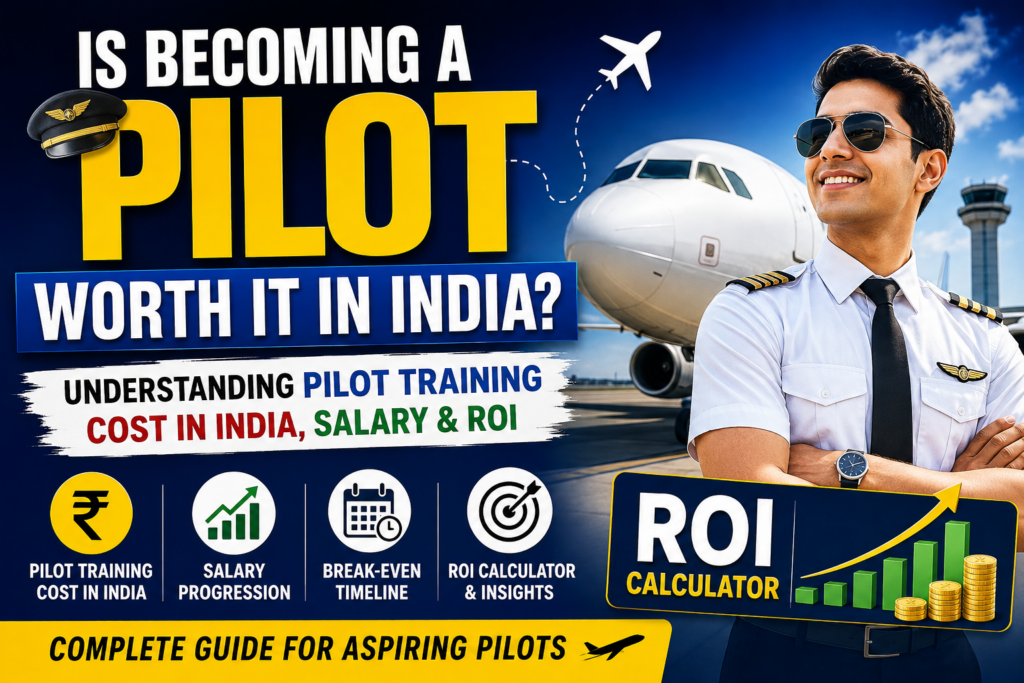
Is Becoming a Pilot Worth It in India? Understanding Pilot Training Cost in India, Salary & ROI
Pilot training cost in India can be a significant investment, often requiring several tens of lakhs of rupees before an aspiring pilot begins earning an airline salary. Whether becoming a pilot is financially worthwhile depends on the total training investment, time taken to complete training, waiting period before employment, starting salary, promotions, salary increments and personal expenses. A realistic ROI calculation should therefore consider the entire career pathway—not simply divide training cost by starting salary.
Table of Contents
- What Is Pilot Training ROI?
- Why Does Pilot Training ROI Matter?
- How Much Does Pilot Training Cost in India?
- What Does the Total Pilot Training Investment Include?
- How Long Does It Take to Become a Commercial Pilot in India?
- What Are the Eligibility Requirements for a CPL in India?
- What Are the Medical Requirements for Commercial Pilots?
- What DGCA Exams Are Required for a CPL?
- What Is the Complete Path from Student to Airline Pilot?
- CPL vs Cadet Pilot Program: Which Has Better ROI?
- How Much Does a Commercial Pilot Earn in India?
- How Does Pilot Salary Increase With Career Progression?
- How Long Does It Take to Recover Pilot Training Investment?
- What Factors Can Delay Pilot ROI?
- What Are the Advantages of Becoming a Pilot?
- What Are the Challenges of Becoming a Pilot?
- What Mistakes Can Reduce Pilot Training ROI?
- How Can You Improve Your Pilot Training ROI?
- What Is the Pilot Career ROI Calculator?
- Frequently Asked Questions
- Final Takeaway
What Is Pilot Training ROI?
Pilot training cost in India is one of the most important inputs when evaluating pilot training ROI. Pilot training ROI is the relationship between the money invested in becoming a commercial pilot and the income generated over the pilot's career. A useful ROI calculation considers training expenses, the time before employment, starting salary, salary increments, promotions, personal expenses and other career-related costs.
A simple pilot training cost in India calculation such as:
can be misleading.
A pilot may complete training but spend several months waiting for employment. A Junior First Officer (JFO) may then progress to First Officer, Senior First Officer and eventually Captain, with income changing substantially at each stage.
A realistic pilot ROI model should therefore consider:
- Initial training investment
- Training duration
- Waiting period before employment
- Starting JFO salary
- Annual salary increments
- Promotion to First Officer
- Promotion to Senior First Officer
- Promotion to Captain
- Personal expenses
- Type Rating or additional training
- Changes in airline hiring conditions
Why Does Pilot Training ROI Matter?
Pilot training ROI matters because becoming an airline pilot requires a substantial upfront investment, and the financial outcome depends on how quickly the pilot moves from training to paid employment and progresses through the airline career ladder. ROI analysis helps students and parents compare training routes, understand financial risk and make better-informed decisions.
Before enrolling, ask five questions:
- What will my complete training investment be?
- How long will I realistically take to complete training?
- How long could I wait before starting paid airline employment?
- What salary progression should I realistically model?
- What happens if training or employment takes longer than expected?
The answers are more useful than looking at a single advertised course fee because pilot training cost in India should be evaluated as a complete career investment rather than as one headline number.
How Much Does Pilot Training Cost in India?
Pilot training cost in India varies substantially depending on the Flying Training Organisation (FTO), aircraft fleet, flying rates, training duration, location, additional flying requirements and the career pathway selected. Students should evaluate the complete cost of obtaining a CPL rather than comparing only the headline flying-school fee.
| Expense | What to Consider |
|---|---|
| CPL flying training | Usually the largest component of the training investment. |
| DGCA ground training | Academic preparation for the applicable theoretical examinations. |
| Medical examinations | Required aviation medical assessments and associated expenses. |
| DGCA examinations | Examination and related administrative expenses. |
| Licensing and documentation | Applicable documentation and licensing-related costs. |
| Accommodation | Important for students training away from home. |
| Food and daily expenses | Depends on the training location and lifestyle. |
| Travel | Home-to-training-location travel and local transportation. |
| Additional flying | May be required depending on training progress. |
| Type Rating | May become relevant depending on the airline and career pathway. |
| Contingency | Recommended for unexpected training and living expenses. |
The Government of India is also increasing transparency around flying training organisations. The Ministry of Civil Aviation currently lists 41 FTOs and 63 operational bases as of 2 July 2026.
For students comparing pilot training cost in India and flying schools, the Ministry of Civil Aviation's official Flying Training Organisations information is a useful reference.
In April 2026, the Ministry of Civil Aviation released the second phase of its DGCA-approved FTO ranking mechanism. The framework is intended to support objective comparison and continuous monitoring of FTO performance.
Read the official FTO Ranking announcement from the Press Information Bureau before comparing training organisations.
Why the cheapest FTO may not produce the lowest total cost
A lower advertised fee does not automatically mean a lower final investment when comparing pilot training cost in India.
| Factor | School A | School B |
|---|---|---|
| Advertised training fee | ₹55 lakh | ₹60 lakh |
| Training delays | Higher | Lower |
| Aircraft availability | Limited | Better |
| Additional flying | ₹5 lakh | ₹1 lakh |
| Accommodation | ₹4 lakh | ₹2 lakh |
| Illustrative final investment | ₹64 lakh | ₹63 lakh |
The example above is illustrative. The second option can ultimately be cheaper despite having the higher advertised fee.
The right question is not "Which school is cheapest?" but "What is my realistic total cost to become employable?"
What Does the Total Pilot Training Investment Include?
When calculating pilot training cost in India, the total investment should include every major cost from the beginning of training until the student is ready to pursue an airline position. Students should avoid evaluating ROI using only the CPL flying-school fee.
1. Flying Training
Flying is usually the largest component of CPL training. The applicable DGCA requirements should always be checked against current regulations and the student's specific licensing pathway.
2. Ground Training
Ground-school preparation covers the theoretical knowledge required for the licensing pathway. Preparation commonly includes subjects such as Air Regulations, Air Navigation, Aviation Meteorology, Technical General, Technical Specific and Radio Telephony requirements.
Students can explore ALPS CPL training and DGCA ground preparation for information about the academic component of pilot training.
3. Medicals
Medical fitness is a critical part of pilot training, and it should be considered early when planning pilot training cost in India because medical eligibility can affect the financial viability of the pathway. Students should not treat medical assessment as a formality because medical eligibility can materially affect whether a student can continue toward a professional pilot career.
4. Examinations and Licensing
Students should budget for applicable examination, documentation and licensing expenses.
The official DGCA Pariksha portal provides information about flight crew examinations, schedules and examination-related notices.
5. Accommodation and Living Expenses
Students evaluating pilot training cost in India should also include accommodation, food, local transportation, travel, study materials and miscellaneous expenses when training away from home.
6. Additional Flying
Students should keep a contingency because actual training hours and costs can vary.
7. Type Rating
A Type Rating is additional aircraft-specific training that may become relevant when moving into airline operations, depending on the airline and recruitment pathway.
For students interested in Airbus A320 preparation, ALPS provides A320 Fixed Base Simulator Training designed to provide exposure to cockpit procedures and airline-oriented operations.
How Long Does It Take to Become a Commercial Pilot in India?
The time required to become a commercial pilot varies according to medical processing, DGCA examinations, flying-school availability, weather, aircraft availability, individual performance and administrative processing. A focused student may complete the core training pathway relatively quickly, but students should avoid planning their finances around an unrealistically short timeline.
The broad pathway generally involves:
Training duration directly affects pilot training cost in India and overall ROI because every additional month can result in additional accommodation, food, transportation, flying and opportunity costs while also delaying future salary.
Students can read more about the pilot training pathway in Mumbai and Pune before planning their training timeline.
What Are the Eligibility Requirements for a CPL in India?
Aspiring commercial pilots in India need to meet the applicable educational, age, medical, examination, flight-experience and licensing requirements under DGCA rules. Candidates should verify the current requirements directly with DGCA because aviation regulations and procedures can change.
The professional pathway generally involves:
- 10+2 or equivalent education with Physics and Mathematics
- Meeting the applicable age requirements
- Appropriate DGCA medical certification
- Required theoretical knowledge examinations
- Required flight experience
- Applicable skill test and licensing requirements
- English-language requirements
- Other documentation required by DGCA
Students planning pilot training cost in India should verify current licensing requirements directly through the official Directorate General of Civil Aviation website.
What Are the Medical Requirements for Commercial Pilots?
Medical assessment should be one of the first steps in a professional pilot career plan, not an afterthought. A candidate's medical status can affect eligibility and therefore the financial viability of pilot training.
The professional pathway involves DGCA medical requirements, including Class 2 and Class 1 medical processes as applicable.
A sensible approach is:
- Understand the applicable medical requirements.
- Complete the appropriate preliminary medical assessment.
- Proceed with the required DGCA medical process.
- Keep medical documentation current.
- Verify current requirements directly with DGCA.
What DGCA Exams Are Required for a CPL?
DGCA theoretical examinations form an important part of the CPL pathway, and students should plan examination preparation alongside flying rather than treating theory as a secondary requirement. The exact examination structure and applicable subjects should always be confirmed against current DGCA requirements.
Typical CPL theory preparation may include:
- Air Regulations
- Air Navigation
- Aviation Meteorology
- Technical General
- Technical Specific
- Radio Telephony requirements
The official DGCA Pariksha examination portal states that the Central Examination Organisation conducts examinations for flight crew licensing in accordance with the applicable regulatory framework.
Students preparing for these subjects can also explore DGCA CPL Ground School Subjects at ALPS.
What Is the Complete Path from Student to Airline Pilot?
Understanding pilot training cost in India requires looking at the entire journey from a Class 12 student to an airline pilot, because the pathway involves several stages rather than one single course. The broad pathway is education and medical eligibility → DGCA requirements → CPL ground preparation → DGCA examinations → flying training → CPL completion → airline/cadet preparation → airline selection → aircraft-specific training → airline operations.
Step 1: Complete educational requirements
Physics and Mathematics at the required level are important for the CPL pathway.
Step 2: Establish medical eligibility
Complete the relevant DGCA medical process early.
Step 3: Begin DGCA ground preparation
Build strong conceptual knowledge in the required subjects.
Step 4: Complete DGCA examinations
Clear the applicable theory papers.
Step 5: Complete flight training
Train at an appropriately approved FTO and complete the applicable flying requirements.
Step 6: Obtain the CPL
Complete the applicable licensing requirements.
Step 7: Prepare for airline selection
Depending on the chosen route, preparation may involve aptitude testing, technical assessments, interviews, psychometric testing, group exercises and other airline-specific selection requirements.
Step 8: Complete airline-specific training
Depending on the employer and pathway, this may include aircraft-specific training such as Airbus A320 training.
Step 9: Begin airline operations
The pilot may begin the airline career pathway as a Junior First Officer or another designated entry-level position, depending on the airline's structure.
CPL vs Cadet Pilot Program: Which Has Better ROI?
Neither a conventional CPL route nor a cadet pilot program automatically has better ROI for every student. The better option depends on total cost, selection probability, airline linkage, financing, training structure, contractual obligations and what happens if the student does not progress through the program.
| Factor | Conventional CPL Route | Cadet Pilot Program |
|---|---|---|
| Initial structure | Flexible | More structured |
| Airline linkage | Usually pursued separately | Usually linked to a specific airline/pathway |
| Selection | Airline application after training | Selection before or during the pathway |
| Cost | Varies significantly | Can be higher depending on program |
| Flexibility | Higher | Lower |
| Airline-specific preparation | Student manages separately | Usually integrated |
| Selection risk | Mainly later | Significant during selection |
| Career planning | More flexible | More defined |
| ROI | Depends on employment pathway | Depends heavily on successful progression |
When a conventional CPL route may make sense
- Students who want flexibility in airline choice
- Students comfortable applying to airlines after training
- Students who prefer managing their own training pathway
- Students who want to compare airline opportunities later
When a cadet pathway may make sense
- Students who prefer a structured airline-linked pathway
- Students who meet the program's eligibility requirements
- Students who perform well in selection assessments
- Students who understand contractual and financial obligations
- Students who have evaluated what happens if they do not complete the pathway
Students interested in cadet preparation can explore ALPS Cadet Pilot Programme Preparation.
ROI should never be evaluated solely from the advertised airline salary. The probability of successfully progressing through the pathway matters just as much.
How Much Does a Commercial Pilot Earn in India?
Commercial pilot salary in India is a major factor when assessing pilot training cost in India and varies according to airline, aircraft, rank, experience, flying hours, allowances, employment structure and market conditions. A student's financial model should therefore use an editable assumption rather than treating one salary figure as guaranteed.
For the ALPS ROI calculator, we use ₹2.5 lakh per month as an illustrative starting JFO salary assumption. This is a model input, not a guaranteed industry-wide salary.
Pilot compensation can change substantially as a pilot progresses through the airline hierarchy:
The salary difference between these stages is one of the most important reasons that a long-term ROI model is more useful than calculating ROI using only the starting salary.
How Does Pilot Salary Increase With Career Progression?
When assessing the long-term value of pilot training cost in India, pilot earnings can increase through both annual increments and promotions to higher ranks. A realistic financial model should therefore separate ordinary salary increments from promotion-related increases. Airline-specific salary structures vary, so the figures below should be treated as illustrative assumptions rather than guaranteed salary bands.
| Rank | Illustrative Career Stage | Illustrative Monthly Salary |
|---|---|---|
| Junior First Officer | Year 1 | ₹2.50 lakh |
| First Officer | Year 3 | ₹3.25 lakh |
| Senior First Officer | Year 6 | ₹4.25 lakh |
| Captain | Year 9 | ₹6.50 lakh |
The ALPS calculator also applies an annual increment within each rank. Users can change the increment percentage and promotion timelines to create their own scenarios.
This is important because:
How Long Does It Take to Recover Pilot Training Investment?
The break-even period for pilot training cost in India depends on the total initial investment, waiting period before employment, salary progression and personal expenses. A student who invests ₹70–80 lakh but begins earning quickly may reach break-even sooner than a student with the same investment who experiences training delays or a longer employment gap.
Illustrative example
- Total investment: ₹78.5 lakh
- Waiting period: 6 months
- Starting JFO salary: ₹2.5 lakh/month
- Annual increment: 6%
- FO promotion: Year 3
- Senior FO promotion: Year 6
- Captain promotion: Year 9
- Monthly personal expenses: ₹50,000
The actual break-even point will depend on the resulting cash-flow calculation.
This is why the ALPS Pilot Career ROI Calculator allows students to change the assumptions rather than giving every student the same answer.
What Factors Can Delay Pilot ROI?
The biggest risks to pilot training cost in India and pilot ROI are training delays, additional flying costs, medical issues, examination delays, extended waiting periods before airline employment and unexpected career-transition expenses. A financially responsible pilot-training plan should include a contingency rather than assuming the fastest possible route.
1. Flying delays
Aircraft availability, weather, maintenance and scheduling can affect training progress.
2. Additional flying
Some students may require additional hours beyond their initial training plan.
3. Examination delays
Repeated attempts or poor preparation can extend the timeline.
4. Medical complications
Medical eligibility is fundamental to a professional pilot career.
5. Airline hiring cycles
Completing a CPL does not automatically mean immediate airline employment.
6. Type Rating expenses
Depending on the airline pathway, aircraft-specific training may add substantial costs.
7. Personal expenses
Accommodation and living expenses continue even when the student is not yet earning.
8. Training gaps
Long gaps between training stages can increase both direct and indirect costs.
What Are the Advantages of Becoming a Pilot?
Becoming an airline pilot can offer strong long-term earning potential, professional progression, international exposure and a highly specialised career. The financial benefits become more meaningful when viewed over a full career rather than only the first year after training.
- Strong long-term earning potential
- Structured career progression
- Opportunity to operate advanced aircraft
- International travel and exposure
- Highly specialised professional skills
- Opportunities across airlines and aviation sectors
- Potential progression toward command
- Opportunities outside airlines, including instruction and other aviation roles
A pilot may eventually explore airline operations, cargo operations, charter aviation, corporate aviation, flight instruction, training and checking roles or aviation management.
What Are the Challenges of Becoming a Pilot?
Pilot training is a high-investment career pathway with financial, academic, medical and employment risks. Students should enter the profession because they understand both the opportunities and the challenges, not simply because pilot salaries appear attractive.
- High upfront investment
- Medical eligibility requirements
- Difficult theoretical examinations
- Demanding flying training
- Variable training timelines
- Airline selection competition
- Potential employment gaps
- Additional training costs
- Irregular working hours
- Time away from home
- Continuous training and checking
What Mistakes Can Reduce Pilot Training ROI?
The biggest mistakes in evaluating pilot training cost in India usually happen before or during training rather than after employment. Students can reduce financial risk by validating medical eligibility, comparing the complete training cost, researching FTO performance, planning financing and understanding the airline pathway before paying large amounts.
Mistake 1: Looking only at the advertised course fee
Always calculate the complete training investment.
Mistake 2: Ignoring additional flying
Ask the FTO what happens if additional hours are required.
Mistake 3: Starting without understanding medical requirements
Medical eligibility should be established early.
Mistake 4: Assuming CPL equals an airline job
A CPL is an important professional licence, but airline recruitment is a separate career step.
Mistake 5: Using starting salary as lifetime salary
Pilot income can change significantly through promotions and increments.
Mistake 6: Ignoring the waiting period
Every month without income affects the ROI calculation.
Mistake 7: Choosing an FTO only because it is cheaper
Training quality, aircraft availability, operational efficiency and student support can influence total cost and completion time.
Mistake 8: Ignoring FTO performance data
Use the official FTO ranking information published by the Government of India as one of the data points when evaluating flying training organisations.
How Can You Improve Your Pilot Training ROI?
Improving the ROI of pilot training cost in India is primarily about reducing avoidable delays, controlling total training costs and improving the probability of moving efficiently from training to employment. The objective should not be to choose the cheapest training option, but to build the most reliable pathway to becoming an employable commercial pilot.
1. Validate medical eligibility early
Do not commit a large investment before understanding whether you meet the required medical standards.
2. Compare total cost, not advertised cost
Include flying, ground training, medicals, accommodation, travel, examinations, licensing and contingencies.
3. Research FTO performance
Use DGCA and Ministry of Civil Aviation information alongside direct questions to the FTO. India's FTO ranking framework provides an additional data point for comparing approved training organisations.
4. Build strong DGCA theory fundamentals
Passing examinations efficiently can reduce avoidable delays.
Students considering structured ground preparation can explore DGCA and pilot ground classes at ALPS.
5. Plan the airline stage before finishing the CPL
Airline preparation should not begin only after the CPL is complete. Students can prepare for aptitude tests, interviews, psychometric assessments and airline-specific selection requirements during their broader training journey.
ALPS provides Cadet Pilot Programme preparation for students targeting structured airline selection pathways.
What Is the Pilot Career ROI Calculator?
The Pilot Career ROI Calculator estimates how long it could take to recover a student's pilot-training investment based on training cost, waiting period, salary progression, promotions and personal expenses. The calculator uses editable assumptions so students can replace illustrative values with their own expected costs and salary estimates.
Estimate Your Pilot Career ROI
Enter your expected pilot training cost in India and career assumptions to estimate how long it could take to recover your investment.
Training Investment
Career & Salary Assumptions
Adjust the assumptions above and calculate your estimated career ROI.
Estimated Pilot Career Progression
10-Year Earnings Recovery
Important: This calculator provides an illustrative estimate only. Actual pilot training costs, airline salaries, promotion timelines, hiring conditions, taxes, allowances, type-rating requirements and personal expenses vary. The calculation does not guarantee employment, salary, promotion or investment returns.
What Does the Calculator Consider?
- CPL/flying training
- Ground training
- Medical, examination and licensing expenses
- Type Rating
- Contingency expenses
- Waiting period before earning
- JFO starting salary
- Annual salary increments
- First Officer promotion
- Senior First Officer promotion
- Captain promotion
- Monthly personal expenses
The calculator deliberately separates rank progression from ordinary annual increments.
This is important because:
can have a much greater effect on long-term earnings than a simple annual percentage increase.
How Should You Interpret the Result?
The calculator should be treated as a financial planning illustration for pilot training cost in India, not a prediction.
A result such as "break-even in 4 years" does not mean every pilot will recover the investment in four years.
Actual results can change because of:
- Training duration
- Employment timing
- Airline salary structure
- Promotion speed
- Additional training
- Taxes
- Personal expenses
- Market conditions
- Individual performance
The calculator is most useful for scenario planning.
Frequently Asked Questions
Is becoming a pilot worth the investment in India?
Becoming a pilot can be financially worthwhile for students who understand pilot training cost in India and successfully progress into airline employment. The answer depends on total training cost, employment timeline, salary progression and career longevity. Students should evaluate pilot training as a long-term career investment rather than expecting immediate recovery of the training cost after receiving a CPL.
What is the pilot training cost in India?
Pilot training cost in India varies depending on the FTO, flying rates, aircraft, training duration, additional flying, accommodation and the chosen career pathway. A complete budget should account for every major expense before training begins. Students should calculate the complete cost rather than relying on an advertised CPL fee. A realistic budget should include flying, ground training, medicals, examinations, accommodation, living expenses, travel, contingencies and potentially Type Rating.
How much does a commercial pilot earn in India?
Commercial pilot salary in India varies by airline, rank, aircraft, experience, allowances and flying activity. Entry-level compensation should not be treated as a fixed industry-wide number. For financial planning, an editable salary assumption is preferable. The ALPS ROI calculator uses ₹2.5 lakh per month as an illustrative JFO starting assumption and models subsequent increments and promotions.
How long does it take to become a commercial pilot in India?
The duration varies according to medical processing, examinations, aircraft availability, weather, individual performance and administrative requirements. Students should include a financial buffer rather than assuming the shortest advertised timeline. Training duration directly affects ROI because additional months can create extra expenses while delaying future income.
Is a CPL enough to become an airline pilot?
A CPL is a fundamental professional pilot licence, but pilot training cost in India should be assessed with the understanding that obtaining a CPL does not guarantee an airline job. After completing the licensing pathway, aspiring airline pilots generally need to satisfy airline-specific recruitment, selection and training requirements. Depending on the pathway, additional aircraft-specific training such as an A320 Type Rating may also be relevant.
Is a cadet pilot program better than doing a normal CPL?
A cadet pilot program is not automatically better than a conventional CPL route. Cadet programs can provide a structured airline-linked pathway but may involve higher costs, selection requirements and contractual conditions. A conventional CPL can offer greater flexibility but requires the student to manage airline applications and preparation separately. The best option depends on the student's goals and financial circumstances.
How can I calculate pilot training ROI?
To evaluate pilot training cost in India, calculate the complete initial investment first, then model the waiting period before employment, starting salary, annual increments, promotion-related salary increases and personal expenses. Compare cumulative net earnings against the initial investment. The break-even point occurs when cumulative estimated net earnings recover the initial investment. A 10-year model provides a more useful view than a first-year salary calculation.
Does pilot salary increase after becoming a First Officer?
Pilot compensation can increase as pilots gain experience and progress through airline ranks. The exact structure differs by airline. A long-term model can therefore include annual increments and separate promotion increases for First Officer, Senior First Officer and Captain. The ALPS calculator uses these stages to illustrate how career progression can affect cumulative earnings.
What can delay the ROI of pilot training?
Training delays, additional flying, examination attempts, medical issues, accommodation costs and a longer-than-expected period before airline employment can delay ROI. Additional aircraft-specific training can also increase the initial investment. Students should maintain a contingency budget and avoid calculating ROI using only the fastest possible training timeline.
Should I choose a flying school based only on price?
No. Price should be one factor rather than the only factor. Students should compare aircraft availability, training timelines, operational performance, additional-hour policies, instructor availability, location, accommodation and overall student support. India's FTO ranking framework provides another useful data point when comparing approved training organisations.
Can I calculate pilot ROI before starting training?
Yes. Calculating ROI before committing to training can help identify the financial risks of the career pathway. Students can model different training investments, waiting periods, starting salaries and promotion timelines. The result should be treated as scenario planning rather than a guaranteed financial outcome.
What Is the Final Takeaway on Pilot Training ROI in India?
Pilot training can be a high-value long-term career investment, but the financial outcome depends on much more than the starting salary of an airline pilot. The most useful approach is to calculate the complete training investment, plan for delays, understand the airline pathway and model salary progression from JFO to First Officer, Senior First Officer and Captain.
Before investing in pilot training cost in India or committing to a training pathway, remember these seven principles:
- Know your complete training cost.
- Complete the required medical process early.
- Compare FTOs on more than price.
- Plan for training and employment delays.
- Do not assume CPL automatically means an airline job.
- Model salary increments and promotions.
- Calculate your own ROI rather than relying on generic salary claims.
The goal of evaluating pilot training cost in India should not simply be to become a pilot.
The goal should be to build a financially sustainable pathway to becoming an airline pilot.
Ready to Plan Your Pilot Career?
If you are considering CPL training, an airline cadet program or airline-preparation training, Airline Prep School (ALPS) can help you understand the available pathways and prepare for the academic and selection stages.
Explore ALPS Pilot Training Programs
- DGCA CPL Ground Classes
- Cadet Pilot Programme Preparation
- A320 Fixed Base Simulator Training
- Explore All ALPS Aviation Courses
ALPS Mumbai
103, B Wing, Rassaz Castle CHS, Malpadongri No. 1, Opp. Gundavali Bus Stop, Near Western Express Highway Metro Station, Andheri East, Mumbai, Maharashtra 400093.
Phone: +91 9222111043 / +91 9222111042
ALPS Pune
Second Floor Unit, Above Ganesh Bhel, Opp. FC College Main Gate, Fergusson College Road, Pune, Maharashtra 411004.
Phone: +91 9461777222
Before choosing a pathway, speak with a qualified aviation counsellor and verify current DGCA requirements and airline-specific conditions.
Talk to Airline Prep School