
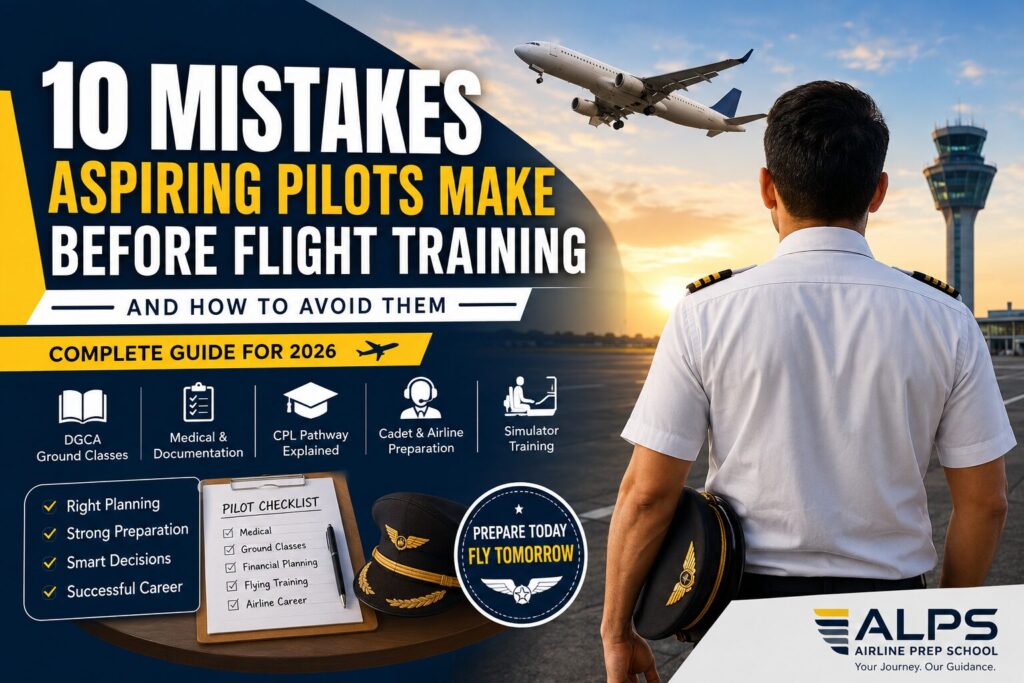
Top 10 Mistakes Aspiring Pilots Make Before Starting Flight Training (And How to Avoid Them)
Last Updated: June 2026
Quick Answer
The biggest mistakes aspiring pilots make before starting flight training include delaying their DGCA Class 1 Medical, choosing a flying school based only on low fees, underestimating the importance of DGCA ground classes, failing to budget for the complete training journey, and beginning without understanding the entire Commercial Pilot Licence (CPL) process. Avoiding these mistakes can save months of delays, reduce unnecessary expenses, and improve your chances of becoming an airline pilot successfully.
Table of Contents
- What Are the Most Common Mistakes Aspiring Pilots Make Before Starting Flight Training?
- Why Avoiding These Mistakes Can Save You Time, Money and Delays
- Mistake #1 – Starting Flight Training Without Understanding the Complete Pilot Journey
- Mistake #2 – Ignoring DGCA Class 1 Medical Until the Last Minute
- Mistake #3 – Choosing a Flying School Based Only on Fees
- Mistake #4 – Underestimating DGCA Ground Classes
- Mistake #5 – Not Planning the Complete Cost of Becoming a Commercial Pilot
- Mistake #6 – Weak Preparation in Physics, Mathematics and English
- Mistake #7 – Believing Airline Cadet Programs Are the Only Route
- Mistake #8 – Overlooking Simulator and Interview Preparation
- Mistake #9 – Ignoring Fitness, Communication and Discipline
- Mistake #10 – Waiting Too Long to Begin Preparation
- Expert Checklist Before Joining a Flying Training Organisation
- How to Choose the Right Ground School
- Frequently Asked Questions
What Are the Most Common Mistakes Aspiring Pilots Make Before Starting Flight Training?
The most common mistakes aspiring pilots make occur before they even enter a cockpit. Many students spend months researching flying schools but overlook equally important aspects such as medical eligibility, financial planning, DGCA examinations, and long-term career preparation. These early decisions often determine how smoothly the rest of the pilot training journey progresses.
Becoming a Commercial Pilot in India involves much more than completing flying hours. Students must satisfy medical requirements, pass DGCA examinations, complete theoretical training, earn a Commercial Pilot Licence (CPL), and continuously build technical knowledge and professional skills. Missing one step can delay the entire process.
Many students also assume that joining a Flying Training Organisation (FTO) automatically guarantees airline employment. In reality, airlines evaluate candidates on multiple parameters, including technical knowledge, communication skills, simulator performance, decision-making ability, discipline, and overall professionalism.
Understanding the complete journey before investing significant time and money helps students make informed decisions and avoid expensive setbacks.
Why Avoiding These Mistakes Can Save You Time, Money and Delays
Every mistake made before flight training has a financial and career impact. Some mistakes can delay pilot training by several months, while others may increase the overall cost by several lakh rupees. Proper planning helps students complete their training more efficiently and prepares them for airline recruitment.
Common Consequences of Poor Planning
- Delayed DGCA Medical approvals
- Unexpected financial burden
- Changing flying schools midway
- Poor performance in DGCA examinations
- Additional accommodation and travel costs
- Longer CPL completion timeline
- Lower confidence during airline assessments
Students who prepare early often complete their licences faster because they understand each stage of the training process before making major financial commitments.
Mistake #1 – Starting Flight Training Without Understanding the Complete Pilot Journey
Direct Answer: One of the biggest mistakes aspiring pilots make is beginning flight training without understanding every stage required to become an airline pilot. Many students only focus on joining a flying school and overlook licensing requirements, DGCA examinations, medical certifications, ground school, and airline selection processes.
The journey to becoming a Commercial Pilot in India generally follows this sequence:
- Complete Class 12 with Physics and Mathematics.
- Obtain a DGCA Class 2 Medical.
- Apply for a DGCA Class 1 Medical.
- Join DGCA Ground Classes.
- Clear DGCA theoretical examinations.
- Complete flying training at a DGCA-approved Flying Training Organisation.
- Accumulate the required flying hours.
- Obtain a Commercial Pilot Licence (CPL).
- Complete additional ratings if required.
- Prepare for airline recruitment.
Why This Matters
Students who understand the complete roadmap are better equipped to budget accurately, select the right training providers, prepare for examinations, and avoid unnecessary delays. They are also more likely to stay motivated because they know what milestones lie ahead.
Expert Insight
Many aspiring pilots focus only on the excitement of flying an aircraft. However, experienced aviation professionals know that success depends equally on theoretical knowledge, discipline, regulatory compliance, and consistent preparation.
Mistake #2 – Ignoring DGCA Class 1 Medical Until the Last Minute
Direct Answer: Delaying the DGCA Class 1 Medical examination is one of the costliest mistakes aspiring pilots make. Without medical fitness approval, a student cannot progress towards obtaining a Commercial Pilot Licence, regardless of academic performance or flying ability.
The DGCA Class 1 Medical evaluates whether a candidate meets the medical standards required to safely operate an aircraft. It includes examinations related to vision, hearing, cardiovascular health, respiratory health, neurological condition, and overall physical fitness.
Many students mistakenly assume they should complete the medical only after joining a flying school. This often leads to unnecessary delays if additional tests or observations are required.
Benefits of Completing the Medical Early
- Confirms eligibility before investing significant money.
- Reduces training interruptions.
- Provides time to address medical observations if required.
- Improves overall planning.
- Avoids uncertainty during admissions.
Common Misconception
A large number of students believe passing the DGCA examinations guarantees a pilot career. In reality, medical fitness is equally important throughout a pilot's professional career.
Mistake #3 – Choosing a Flying School Based Only on Fees
Direct Answer: Selecting a Flying Training Organisation solely because it offers the lowest fees can become an expensive decision in the long run. Training quality, aircraft availability, instructor experience, maintenance standards, weather conditions, and student support all influence the overall learning experience.
While cost is naturally an important factor, it should never be the only deciding criterion. A lower initial fee may lead to extended training durations, additional accommodation expenses, delayed flying schedules, or extra costs due to aircraft unavailability.
Factors to Evaluate Before Choosing a Flying School
| Factor | Why It Matters |
|---|---|
| DGCA Approval | Ensures regulatory compliance. |
| Aircraft Availability | Reduces waiting time for flying slots. |
| Instructor Experience | Improves learning quality. |
| Maintenance Standards | Supports safe and uninterrupted training. |
| Weather Conditions | Affects annual flying hours. |
| Student Support | Helps with documentation and examinations. |
| Placement Guidance | Assists students preparing for airline recruitment. |
Expert Recommendation
Before paying any admission fee, speak with current students, compare multiple Flying Training Organisations, review their operational history, understand expected training timelines, and clarify every cost involved. A well-informed decision today can prevent expensive surprises later.
Many students also benefit from enrolling in a reputed DGCA ground school before beginning flight training. Strong theoretical preparation makes flying lessons more productive and builds a solid foundation for future airline assessments.
Mistake #4 – Underestimating the Importance of DGCA Ground Classes
Direct Answer: Many aspiring pilots believe that flying an aircraft is the most challenging part of becoming a commercial pilot. In reality, a strong understanding of aviation theory is equally important. DGCA Ground Classes build the knowledge required to pass licensing examinations, make safe decisions in the cockpit, and perform confidently during airline selection processes.
Before earning a Commercial Pilot Licence (CPL), every student must develop a solid understanding of aviation regulations, navigation, meteorology, aircraft technical systems, and radio communication procedures. These subjects form the foundation upon which practical flying skills are built.
Students who underestimate theoretical preparation often struggle during DGCA examinations and later during airline technical interviews. Even experienced pilots regularly revise these subjects throughout their careers because aviation is a profession built on continuous learning.
Core DGCA CPL Subjects
| Subject | Why It Is Important |
|---|---|
| Air Navigation | Flight planning, charts, navigation systems and route calculations. |
| Meteorology | Understanding weather conditions and their effect on flight safety. |
| Air Regulations | DGCA rules, aviation law and operational procedures. |
| Technical General | Aircraft systems, engines, aerodynamics and aircraft performance. |
| RTR (Radio Telephony Restricted) | Professional radio communication with Air Traffic Control. |
Why Ground Classes Should Come Before Flying
- Build confidence before entering the cockpit.
- Improve understanding during practical flying lessons.
- Increase the likelihood of clearing DGCA examinations on the first attempt.
- Develop professional aviation terminology from the beginning.
- Prepare students for airline technical interviews.
Expert Insight
Students who begin flying with a strong theoretical foundation generally absorb practical lessons faster because they already understand aircraft systems, navigation principles and operational procedures. Instead of memorising instructions, they understand the reasons behind every action performed in the cockpit.
Choosing the Right Ground School
When evaluating a ground school, consider the following factors rather than focusing only on course fees:
- Experienced DGCA instructors.
- Structured classroom learning.
- Updated study material aligned with current DGCA syllabi.
- Regular mock examinations.
- Individual doubt-solving sessions.
- Cadet programme preparation support.
- Simulator exposure wherever available.
Airline Prep School (ALPS) prepares aspiring pilots through structured DGCA Ground Classes, pilot cadet programme preparation, psychometric guidance and Airbus A320 Fixed Base Simulator sessions. Students benefit from an integrated learning environment that bridges theoretical concepts with real-world airline operations.
Mistake #5 – Not Planning the Complete Cost of Becoming a Commercial Pilot
Direct Answer: One of the most expensive mistakes aspiring pilots make is budgeting only for flight training fees while overlooking the many additional expenses involved in becoming a commercial pilot. Proper financial planning helps students avoid interruptions, delayed training and unnecessary stress during their aviation journey.
The cost of becoming a Commercial Pilot in India varies depending on the Flying Training Organisation, aircraft type, flying hours, location and exchange rates if training is completed overseas. While exact figures differ, students should prepare for the complete journey instead of only the advertised flying package.
Estimated Cost Breakdown
| Expense | Approximate Cost (INR) |
|---|---|
| DGCA Ground Classes | ₹1.5 – ₹2.5 Lakhs |
| Class 1 & Class 2 Medical | ₹8,000 – ₹20,000 |
| DGCA Examination Fees | Varies by examination |
| RTR Preparation & Examination | ₹20,000 – ₹60,000 |
| Commercial Flight Training | ₹45 – ₹65 Lakhs |
| Accommodation & Living Expenses | Depends on location |
| Uniforms & Headsets | ₹30,000 – ₹1 Lakh+ |
| Study Material | ₹10,000 – ₹50,000 |
| Licence Documentation | As applicable |
Note: These figures are approximate estimates and may vary depending on the training provider, location, regulatory updates and individual circumstances.
Hidden Expenses Most Students Don't Consider
Many aviation websites mention only the cost of flying hours. However, several additional expenses should also be included while planning your budget.
- Accommodation deposits.
- Daily transportation.
- Laptop and software requirements.
- Internet and study subscriptions.
- Additional flying hours if required.
- Medical renewals.
- Travel for DGCA examinations.
- Document verification and certification.
- Pilot logbooks.
- Visa and travel expenses (for overseas training).
- Interview preparation courses.
- Simulator practice sessions.
Common Financial Mistakes
| Mistake | Possible Consequence | Better Approach |
|---|---|---|
| Choosing the cheapest option available. | Poor training quality or delayed completion. | Compare overall value rather than only fees. |
| Ignoring living expenses. | Unexpected financial pressure. | Create a complete monthly budget. |
| No emergency fund. | Training interruptions. | Keep a financial buffer for unforeseen expenses. |
| Paying full fees without research. | Limited flexibility if expectations are not met. | Understand payment schedules and refund policies. |
Questions Every Student Should Ask Before Paying Any Fees
- Is the Flying Training Organisation approved by the DGCA?
- How many aircraft are currently operational?
- What is the average waiting time for flying slots?
- What additional costs are not included in the quoted fees?
- How long does students typically take to complete training?
- What instructor-to-student ratio does the academy maintain?
- Is accommodation available nearby?
- How is student progress monitored?
- What support is provided for DGCA examinations?
- Does the academy assist with airline interview preparation?
Expert Tip
Rather than asking, "What is the cheapest way to become a pilot?", ask, "Which training pathway provides the best value, strongest knowledge foundation and highest likelihood of completing training on time?" This small shift in thinking often leads to better long-term outcomes.
Students who begin their journey with structured counselling are usually better prepared to understand the complete financial commitment involved. Airline Prep School (ALPS) offers career guidance sessions that help aspiring pilots understand the CPL pathway, DGCA Ground Classes, cadet programmes and the planning required before making significant investments.
Mistake #6 – Weak Preparation in Physics, Mathematics and English
Direct Answer: A strong foundation in Physics, Mathematics and English is essential for aspiring pilots. These subjects influence every stage of pilot training—from understanding aircraft performance and navigation calculations to communicating effectively with Air Traffic Control (ATC). Students who strengthen these fundamentals before starting flight training usually progress faster and perform better in DGCA examinations.
Many students believe that once they have completed Class 12, they no longer need to revise basic concepts. However, commercial pilot training regularly involves mathematical calculations, interpreting technical manuals, understanding aviation physics and communicating clearly in English.
Modern airline operations demand accuracy, quick decision-making and effective communication. Even a minor misunderstanding during radio communication can affect operational safety. Developing these skills early makes the transition into professional aviation much smoother.
Why These Subjects Matter
| Subject | Importance in Pilot Training |
|---|---|
| Physics | Helps understand aerodynamics, aircraft performance, engines and flight principles. |
| Mathematics | Used in navigation, fuel planning, weight & balance, time-speed-distance calculations and flight planning. |
| English | Required for radio communication, airline interviews, SOPs, manuals and international aviation operations. |
Common Weak Areas
- Basic trigonometry used in navigation.
- Speed, distance and time calculations.
- Weather interpretation.
- Technical English vocabulary.
- Listening comprehension during radio communication.
- Professional spoken English during interviews.
Expert Advice
Spend at least 30–45 minutes each day improving your mathematical aptitude and English communication skills. Reading aviation articles, watching aviation documentaries and practising mental calculations can significantly improve confidence before joining a Flying Training Organisation.
Preparation Checklist
- Revise Class 11 and Class 12 Physics concepts.
- Practice basic navigation calculations.
- Improve spoken English through regular conversations.
- Read aviation news daily.
- Learn common aviation abbreviations and terminology.
- Develop confidence in explaining technical concepts verbally.
Mistake #7 – Believing Airline Cadet Programs Are the Only Route
Direct Answer: Airline Cadet Programs are an excellent pathway for many aspiring pilots, but they are not the only route to becoming an airline pilot. The conventional Commercial Pilot Licence (CPL) pathway remains a well-established option that has produced thousands of successful airline pilots in India and worldwide.
One of the biggest misconceptions among students is that failing a cadet programme selection process means their aviation career is over. This is simply not true. Many airline captains currently flying for domestic and international airlines entered the industry through the conventional CPL route.
Both pathways have advantages and considerations. The right choice depends on a student's financial planning, aptitude, career goals, and preparedness for competitive airline assessments.
Conventional CPL vs Airline Cadet Program
| Comparison | Conventional CPL Route | Airline Cadet Program |
|---|---|---|
| Selection Process | Admission to a DGCA-approved Flying Training Organisation. | Highly competitive multi-stage airline selection. |
| Training Structure | Student chooses training providers. | Structured airline-designed programme. |
| Career Flexibility | Can apply to multiple airlines after CPL. | Primarily aligned with the sponsoring airline. |
| Competition Level | Moderate. | Very High. |
| Psychometric Testing | Usually required only during airline recruitment. | Forms an important part of initial selection. |
| Interview Preparation | Student responsibility. | Integrated within programme requirements. |
| Employment | Based on airline recruitment after licence completion. | Subject to successful completion of programme standards. |
How Should Students Decide?
Ask yourself the following questions:
- Am I prepared for a highly competitive airline selection process?
- Have I developed strong aptitude, communication and psychometric skills?
- Would I benefit from gaining additional experience before applying?
- Do I prefer a structured airline pathway or greater career flexibility?
Common Misconception
Many students repeatedly delay their aviation journey while waiting for the "perfect" cadet opportunity. During this period, they often postpone improving technical knowledge, communication skills and DGCA preparation. Regardless of the pathway chosen, early preparation always provides a competitive advantage.
Expert Recommendation
If you intend to apply for an Airline Cadet Program, begin preparing well in advance. Areas such as aptitude testing, psychometric assessments, group discussions, technical knowledge and interview skills require consistent practice and cannot be mastered in a few weeks.
Airline Prep School (ALPS) offers dedicated Airline Cadet Preparation programmes that help students prepare for aptitude tests, psychometric assessments, technical interviews, communication skills and simulator assessments while also providing guidance on the conventional CPL pathway.
Mistake #8 – Overlooking Simulator Training and Interview Preparation
Direct Answer: Many aspiring pilots concentrate entirely on obtaining their Commercial Pilot Licence while overlooking simulator training and airline interview preparation. Although earning a CPL is a major milestone, airlines evaluate candidates on much more than flying hours alone.
Airline recruitment processes commonly include technical interviews, simulator assessments, psychometric evaluations, aptitude tests, group discussions and HR interviews. Students who prepare only after completing their licence often find themselves under unnecessary pressure.
Simulator sessions introduce students to airline-style procedures, cockpit resource management and decision-making in a controlled environment. Even fixed-base simulators help students develop familiarity with cockpit layouts, standard operating procedures and workload management.
Benefits of Early Simulator Exposure
- Improves cockpit familiarity.
- Develops procedural discipline.
- Enhances decision-making under workload.
- Builds confidence before airline assessments.
- Introduces airline-style standard operating procedures.
- Improves teamwork and communication skills.
Airline Recruitment Skills Beyond Flying
| Skill | Why Airlines Value It |
|---|---|
| Technical Knowledge | Demonstrates understanding of aviation fundamentals. |
| Communication Skills | Essential for cockpit coordination and ATC interaction. |
| Decision Making | Critical for operational safety. |
| Crew Resource Management | Measures teamwork and situational awareness. |
| Professional Behaviour | Reflects airline culture and customer expectations. |
| Simulator Performance | Evaluates practical application of theoretical knowledge. |
Industry Observation
Recruiters frequently observe that technically capable candidates sometimes struggle because they have never experienced a structured simulator assessment or professional airline interview. Confidence is built through preparation—not by chance.
Expert Tip
Begin simulator familiarisation and interview preparation while completing your DGCA Ground Classes rather than waiting until after obtaining your licence. This allows you to develop technical knowledge and professional competencies simultaneously.
At Airline Prep School (ALPS), students can gain exposure to an Airbus A320 Fixed Base Simulator while preparing for DGCA examinations and airline cadet selections. Combining classroom learning with simulator practice helps bridge the gap between theory and real-world airline operations.
Mistake #9 – Ignoring Physical Fitness, Communication Skills and Professional Discipline
Direct Answer: Technical knowledge alone does not make a successful airline pilot. Good physical fitness, effective communication skills and professional discipline are equally important. Airlines look for candidates who can operate safely, communicate clearly, work within a team and maintain professionalism under pressure.
Aviation is one of the world's most safety-critical professions. Every flight involves teamwork between pilots, cabin crew, air traffic controllers, engineers and ground operations personnel. Strong communication and disciplined decision-making contribute directly to safe flight operations.
Many aspiring pilots spend months studying technical subjects but neglect their health, confidence and interpersonal skills. These areas become especially important during airline interviews, simulator assessments and eventually throughout a pilot's career.
Areas Every Aspiring Pilot Should Develop
| Skill | Why It Matters | How to Improve |
|---|---|---|
| Physical Fitness | Supports medical fitness and endurance during flight operations. | Exercise regularly, maintain healthy nutrition and adequate sleep. |
| Communication | Essential for ATC communication and cockpit coordination. | Practice spoken English and public speaking. |
| Discipline | Professional aviation relies on procedures and consistency. | Develop structured daily study and time management habits. |
| Teamwork | Pilots rarely work alone. | Participate in group activities and collaborative learning. |
| Situational Awareness | Improves operational decision-making. | Study accident case studies and aviation scenarios. |
Habits That Build Professionalism
- Arrive on time for every class or briefing.
- Maintain organized study notes.
- Stay updated with aviation news.
- Follow standard operating procedures during simulator sessions.
- Develop confidence without overconfidence.
- Accept feedback positively and continuously improve.
Expert Insight
Airlines can teach candidates aircraft-specific procedures, but qualities such as discipline, professionalism and a learning mindset are developed over time. Building these habits before flight training provides a long-term advantage throughout an aviation career.
Mistake #10 – Waiting Too Long to Begin Preparation
Direct Answer: One of the biggest mistakes aspiring pilots make is delaying preparation until after finishing school, college or another career path. Starting early does not mean beginning flight training immediately—it means building the knowledge, medical readiness and financial plan required for a smoother journey.
Many students postpone researching pilot training because they believe there is plenty of time. In reality, early preparation allows students to complete medical examinations, improve academic foundations, understand training costs and make informed career decisions without unnecessary pressure.
Beginning preparation six to twelve months before joining a Flying Training Organisation often results in a more confident and better-prepared student.
Benefits of Starting Early
- More time to prepare for DGCA examinations.
- Opportunity to complete medical requirements in advance.
- Better financial planning.
- Improved communication skills.
- Stronger understanding of aviation fundamentals.
- Reduced stress during admissions.
- Greater confidence during airline assessments.
Common Misconception
Some students believe they should only start preparing after securing admission to a flying school. However, early preparation allows students to maximize the value of every classroom lesson and flying hour once training begins.
Suggested 12-Month Preparation Timeline Before Flight Training
Direct Answer: Preparing over a 12-month period allows aspiring pilots to build technical knowledge, complete medical requirements and plan finances systematically. The following timeline is a practical roadmap that many students can adapt according to their individual circumstances.
| Timeline | Recommended Focus |
|---|---|
| 12 Months Before | Research pilot career pathways, understand CPL requirements and shortlist DGCA-approved Flying Training Organisations. |
| 10 Months Before | Strengthen Physics, Mathematics and English fundamentals. |
| 9 Months Before | Complete DGCA Class 2 Medical and begin the Class 1 Medical process. |
| 8 Months Before | Join DGCA Ground Classes and begin structured theoretical preparation. |
| 6 Months Before | Practice mock tests, improve communication skills and begin aptitude preparation. |
| 4 Months Before | Visit shortlisted flying schools and compare facilities, aircraft and instructors. |
| 3 Months Before | Prepare financial documents and finalize training plans. |
| 2 Months Before | Attend simulator familiarisation sessions and technical workshops. |
| 1 Month Before | Organize documents, accommodation and travel arrangements. |
This timeline is intended as a general planning guide. Individual preparation schedules may vary depending on academic background, medical status and training pathway.
Expert Checklist Before Joining a Flying Training Organisation
Direct Answer: Before paying admission fees or joining a Flying Training Organisation, every aspiring pilot should complete a structured checklist covering medical eligibility, financial planning, academic preparation and career guidance. Doing so helps minimize unexpected delays and improves decision-making.
Pre-Enrollment Checklist
- ✔ Understand the complete Commercial Pilot Licence (CPL) pathway.
- ✔ Verify eligibility requirements.
- ✔ Complete or initiate DGCA Class 1 Medical.
- ✔ Compare multiple DGCA-approved Flying Training Organisations.
- ✔ Research aircraft availability and instructor experience.
- ✔ Understand all training costs and hidden expenses.
- ✔ Prepare a financial contingency plan.
- ✔ Begin DGCA Ground Classes.
- ✔ Improve English communication skills.
- ✔ Revise Physics and Mathematics fundamentals.
- ✔ Practice aptitude and psychometric assessments.
- ✔ Gain simulator exposure if available.
- ✔ Speak with current students or alumni.
- ✔ Clarify documentation requirements.
- ✔ Develop a realistic study schedule.
Mistake → Consequence → Solution
| Mistake | Possible Consequence | Recommended Solution |
|---|---|---|
| Not understanding the CPL pathway. | Confusion and delayed planning. | Research every stage before enrolling. |
| Delaying Class 1 Medical. | Unexpected training delays. | Complete medical assessments early. |
| Choosing a flying school based only on fees. | Lower training quality or extended duration. | Compare facilities, instructors and student support. |
| Ignoring DGCA Ground Classes. | Difficulty clearing examinations. | Build a strong theoretical foundation. |
| Poor financial planning. | Interrupted training. | Create a realistic budget with contingency funds. |
| Weak academic preparation. | Reduced confidence and slower progress. | Revise Physics, Mathematics and English. |
| Believing cadet programmes are the only option. | Missed career opportunities. | Evaluate both conventional CPL and cadet pathways. |
| Skipping simulator preparation. | Lower confidence during airline assessments. | Gain simulator exposure before interviews. |
| Ignoring communication and discipline. | Poor interview performance. | Develop professional habits consistently. |
| Starting preparation too late. | Rushed decisions and unnecessary stress. | Begin planning at least 6–12 months in advance. |
How to Choose the Right Ground School Before Flight Training
Direct Answer: Choosing the right DGCA Ground School is one of the most important decisions an aspiring pilot will make before beginning flight training. A quality ground school not only helps students clear DGCA examinations but also builds the technical knowledge, discipline and confidence required throughout a professional aviation career.
Many students spend months comparing Flying Training Organisations while paying very little attention to the quality of their theoretical preparation. In reality, every stage of pilot training—from DGCA examinations to airline technical interviews—depends upon a strong understanding of aviation fundamentals.
A well-structured ground school should focus on concept-based learning rather than rote memorization. Students should understand why aviation procedures exist, not simply memorize answers for examinations.
What to Look for in a DGCA Ground School
| Evaluation Factor | Why It Matters |
|---|---|
| Experienced Faculty | Learning from instructors with aviation and airline experience improves conceptual understanding. |
| Updated Curriculum | Course material should align with the latest DGCA syllabus and examination pattern. |
| Mock Tests | Regular assessments help identify weak areas before official examinations. |
| Doubt Solving | Individual attention allows students to strengthen difficult concepts. |
| Study Material | Structured notes save time and improve revision efficiency. |
| Simulator Exposure | Practical understanding complements classroom theory. |
| Cadet Preparation | Additional aptitude, psychometric and interview preparation provides a competitive advantage. |
| Student Support | Career counselling and academic guidance help students stay on track. |
Questions You Should Ask Before Joining Any Ground School
- Who teaches each DGCA subject?
- How frequently are mock examinations conducted?
- What is the average batch size?
- Will I receive updated study material?
- Is personal doubt-solving available?
- Does the institute provide guidance beyond DGCA examinations?
- Is simulator familiarisation included?
- Does the institute assist students preparing for Airline Cadet Programs?
Choosing the right ground school is not about finding the cheapest option. It is about finding an institute that prepares you for both licensing examinations and the realities of an airline career.
How Airline Prep School (ALPS) Supports Aspiring Pilots
Choosing the right training partner can significantly influence your learning experience. Airline Prep School (ALPS) was established with the objective of helping aspiring pilots build a strong theoretical foundation before entering the cockpit.
Rather than focusing only on examination preparation, ALPS aims to prepare students for the complete aviation journey—from DGCA Ground Classes to airline assessments.
Students at ALPS Benefit From
- Comprehensive DGCA Ground Classes.
- Experienced aviation instructors.
- Structured classroom learning.
- Regular mock examinations.
- Pilot Cadet Program preparation.
- Psychometric assessment guidance.
- Interview preparation sessions.
- Airbus A320 Fixed Base Simulator exposure.
- Career counselling before choosing a training pathway.
- Campuses in Mumbai and Pune.
Every aspiring pilot has unique career goals. Some students pursue the conventional Commercial Pilot Licence pathway, while others prepare for Airline Cadet Programs. Receiving professional guidance before making significant financial decisions can help students choose the pathway that best aligns with their ambitions.
Frequently Asked Questions
1. What is the biggest mistake aspiring pilots make?
The most common mistake is starting flight training without understanding the complete pilot licensing process. Students should first understand DGCA medical requirements, theoretical examinations, flying training, financial commitments and airline recruitment before enrolling in a Flying Training Organisation.
2. Should I complete my DGCA Class 1 Medical before joining a flying school?
Beginning the DGCA Class 1 Medical process early is generally recommended. It confirms your medical eligibility and reduces the chances of unexpected delays after you have invested significant time and money into pilot training.
3. Are DGCA Ground Classes compulsory?
While students may choose how they prepare, structured DGCA Ground Classes provide expert guidance, organized study material and regular assessments that improve conceptual understanding and examination readiness.
4. Can I become an airline pilot without joining an Airline Cadet Program?
Yes. Thousands of airline pilots have entered the profession through the conventional Commercial Pilot Licence (CPL) pathway. Airline Cadet Programs are one option, but they are not the only route to an airline career.
5. How much does it cost to become a commercial pilot in India?
The overall investment varies depending on the Flying Training Organisation, location and training pathway. Students should budget not only for flying hours but also for medical examinations, ground classes, accommodation, documentation and other associated expenses.
6. How long does it take to become a commercial pilot?
The duration depends on several factors, including weather conditions, aircraft availability, examination schedules and student performance. Many students complete the process within approximately 18 to 24 months, although individual timelines may differ.
7. Why is English important for pilots?
English is the international language of aviation. Pilots use English while communicating with Air Traffic Control, reading aircraft manuals, following operational procedures and participating in airline interviews.
8. What should I look for when choosing a Flying Training Organisation?
Students should evaluate DGCA approval, instructor experience, aircraft availability, safety standards, maintenance quality, student support, infrastructure and overall training quality rather than considering fees alone.
9. Does simulator training help before airline interviews?
Yes. Simulator sessions improve cockpit familiarisation, procedural understanding, decision-making and confidence. Early simulator exposure can also help students understand airline operating procedures before recruitment assessments.
10. When should I begin preparing to become a pilot?
Ideally, students should begin preparing six to twelve months before joining a Flying Training Organisation. Early preparation provides sufficient time for medical examinations, financial planning, DGCA Ground Classes and skill development.
Final Thoughts
Becoming a commercial pilot is a rewarding journey, but success depends on informed decision-making long before the first flight lesson begins. Understanding the complete training process, preparing academically, planning finances carefully and choosing the right learning environment can help aspiring pilots avoid costly mistakes and progress confidently toward their aviation goals.
Every hour invested in preparation today has the potential to save weeks—or even months—during training. The strongest pilots are not simply those who fly well; they are those who prepare well.
Need Guidance Before Starting Your Pilot Journey?
If you're planning to become a Commercial Pilot and would like expert guidance before making any major decisions, Airline Prep School (ALPS) offers educational career counselling to help you understand the complete pathway.
- ✔ Free Career Counselling
- ✔ DGCA Ground Classes
- ✔ Airline Cadet Program Preparation
- ✔ Airbus A320 Fixed Base Simulator Experience
- ✔ Psychometric & Interview Preparation
- ✔ Mumbai Campus
- ✔ Pune Campus
Book a counselling session, attend a demo lecture and make an informed start to your aviation career.
Quick Links & Official Aviation Resources
Planning to become a commercial pilot? Explore these helpful resources to understand DGCA regulations, pilot training, medical requirements, and career pathways. You can also visit our dedicated course pages for detailed guidance.
Explore ALPS Courses & Resources
- Airline Prep School Home
- Book a Free Career Counselling Session
- Read More Aviation Blogs
- Commercial Pilot Licence (CPL)
- DGCA Ground Classes
- Pilot Cadet Program Preparation
- ATPL Ground Classes
- RTR (Radio Telephony) Classes
- Psychometric Test Preparation
- Airbus A320 Fixed Base Simulator
Official Aviation Resources
- Directorate General of Civil Aviation (DGCA)
- eGCA Portal
- DGCA PARIKSHA Portal
- Airports Authority of India (AAI)
- International Civil Aviation Organization (ICAO)