
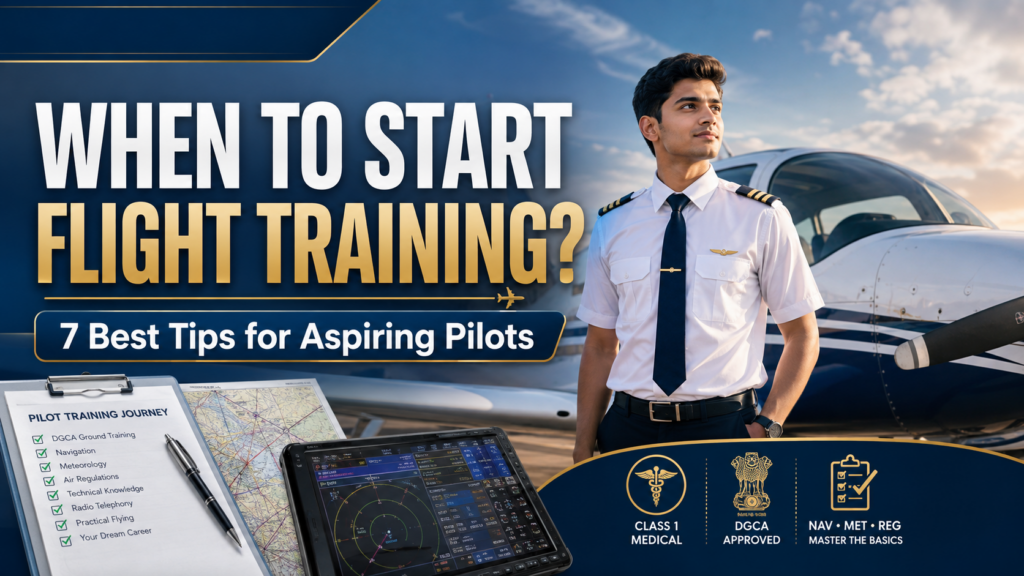
When to Start Flight Training: 7 Best Tips for Pilots
When to start flight training is one of the most important decisions an aspiring pilot makes after beginning DGCA ground classes. Ideally, you should be ready to move into flying once you have cleared Air Navigation, Aviation Meteorology and Air Regulations and have a valid Class 1 Medical Certificate.
Knowing when to start flight training does not necessarily mean waiting until every theory requirement is completed. If one subject among Navigation, Meteorology and Regulations remains pending but you have demonstrated a strong understanding of that subject, you may be able to begin flying while preparing for another examination attempt.
The right time to begin practical flying depends on your examination performance, medical status, flying destination, FTO requirements and overall pilot-training plan.
When should you start flight training?
Direct answer: The ideal time to start flight training is generally after clearing Navigation, Meteorology and Air Regulations, provided you also have a valid Class 1 Medical Certificate. If one of these three subjects remains pending, your previous examination score and actual understanding of the subject should help determine whether you should begin flying or reattempt the examination first.
For an aspiring commercial pilot, the transition from DGCA ground school to flight training should be planned rather than rushed. The objective is to enter practical flying with a strong theoretical foundation and medical clearance.
If you are wondering when to start flight training after DGCA ground classes, use your examination results, medical status and chosen flying pathway as the primary decision points.
| Your Situation | Recommended Approach |
|---|---|
| Navigation, Meteorology and Regulations cleared | Generally, this is a good stage to begin the flying-school process, provided your Class 1 Medical is valid. |
| One subject pending with a previous score above 65 | You may consider beginning flying while preparing for another examination attempt, subject to your training pathway and FTO requirements. |
| One subject pending with a previous score of 60 or below | It is generally better to strengthen your understanding and consider reattempting the examination first. |
| Class 1 Medical not completed or not valid | Do not begin professional flight training. |
| Technical or RTR pending | Plan these requirements according to your individual training and licensing pathway. |
If you are still in the ground-training stage, explore DGCA Ground Classes at Airline Prep School to understand how the theory stage fits into your pilot-training journey.
Why is knowing when to start flight training important?
Direct answer: Knowing when to start flight training can help you avoid unnecessary delays, poor financial decisions and preventable gaps between ground school and practical flying. Starting too early without medical clearance or adequate theoretical preparation can create problems, while waiting unnecessarily after becoming ready can delay your overall CPL timeline.
Flight training is a major financial and time commitment. Your decision about when to start flight training should therefore be based on readiness rather than simply starting as quickly as possible.
- Medical readiness: Your Class 1 Medical should be completed.
- Academic readiness: Your core DGCA subjects should be cleared or well understood.
- Financial readiness: You should understand the complete estimated cost of flying.
- FTO readiness: Your selected flying school should have a suitable training plan.
- Career readiness: You should understand what you intend to do after obtaining your CPL.
Why should you clear Navigation, Meteorology and Regulations before flying?
Direct answer: Navigation, Meteorology and Air Regulations provide an important theoretical foundation for practical flight training. Navigation develops flight-planning and positional awareness, Meteorology develops weather understanding and decision-making, while Air Regulations introduces the rules and procedures that govern aviation operations.
For most students, clearing these three subjects is the ideal academic milestone when deciding when to start flight training.
Why is Air Navigation important?
Air Navigation teaches pilots how to understand aircraft position, direction, routes, headings and flight planning. These concepts become increasingly important as students progress into cross-country and more advanced flying.
- Flight planning
- Routes and tracks
- Headings and bearings
- Charts and navigation concepts
- Position awareness
Why is Aviation Meteorology important?
Aviation Meteorology helps pilots understand weather conditions that can affect flight operations. A strong foundation helps students interpret weather information and make better operational decisions during practical training.
- Weather systems
- Clouds and visibility
- Wind and atmospheric conditions
- Aviation forecasts and reports
- Weather-related operational decisions
Why are Air Regulations important?
Air Regulations gives aspiring pilots an understanding of the rules, procedures and responsibilities associated with aviation operations.
The Directorate General of Civil Aviation (DGCA) is India's civil aviation regulator and is responsible for regulation and safety oversight in civil aviation.
You can check current flight-crew examination information through the official DGCA Pariksha portal.
Students preparing for CPL examinations can also explore ALPS CPL Ground Classes for structured preparation.
When can you start flight training if one DGCA subject is pending?
Direct answer: If one subject among Navigation, Meteorology and Regulations is still pending, you do not necessarily have to stop your entire pilot-training plan. A practical way to assess your readiness is to look at your previous score. If you scored above 65, your theoretical base may be strong enough to consider starting flying while preparing for another attempt. If you scored 60 or below, strengthening the subject first is generally recommended.
This is an important consideration when deciding when to start flight training, because not every unsuccessful examination attempt means that your overall theoretical foundation is weak.
What if you scored above 65?
A score above 65 in a previous attempt can indicate that you already have a reasonably strong understanding of the syllabus, even if you did not clear the examination.
In such a situation, depending on your individual circumstances and FTO requirements, you can consider starting your flying and preparing for the pending examination alongside your training.
What if you scored 60 or below?
A score of 60 or below can indicate that the underlying concepts need more attention. Flight training is demanding, and trying to manage practical flying alongside a weak theoretical subject can create unnecessary pressure.
In this situation, it is generally recommended to strengthen your preparation and attempt the examination again before making a major flying commitment.
ALPS practical guidance: If you have one pending subject, look at the score and your conceptual understanding rather than treating every failed attempt identically. A strong previous score can indicate a different level of readiness from a low previous score.
Do you need Technical and RTR before starting flight training?
Direct answer: Technical and RTR are important parts of the broader pilot-training and licensing pathway, but students do not necessarily need to treat the completion of every theory requirement as the only trigger for beginning practical flying. The appropriate sequence depends on the student's training location, FTO requirements and applicable DGCA requirements.
Understanding the sequence of Technical and RTR is particularly important when deciding when to start flight training abroad.
What if you are flying abroad?
If you are planning to complete your flight training abroad, the practical approach can be different from a student completing the entire training pathway in India.
Once you have cleared your core subjects of Navigation, Meteorology and Regulations and have your Class 1 Medical completed, you may be ready to leave for practical flying, subject to the requirements of your overseas FTO and your licensing pathway.
For students following an overseas pathway, Technical and RTR can be planned for completion after returning from flying where applicable. Practical exposure during flight training can also give students a better operational context for aviation communication and aircraft-related concepts.
However, this should not be interpreted as a universal DGCA rule that Technical or RTR can always be postponed. Your exact examination and licensing requirements should be confirmed before departure.
The official DGCA Pariksha portal should be checked for current examination notices, schedules and requirements.
How does Class 1 Medical affect when to start flight training?
Direct answer: You should complete your Class 1 Medical before starting professional flight training. A valid Class 1 Medical Certificate is a critical part of your professional pilot pathway, and completing it early reduces the risk of making a major financial commitment before knowing whether you meet the applicable medical requirements.
Ideally, your Class 1 Medical should be completed around the same time you are completing Navigation, Meteorology and Regulations.
Your medical status is therefore one of the first things to consider when deciding when to start flight training.
Why should Class 1 Medical come early?
- It helps establish your medical eligibility for professional flying.
- It reduces financial risk before flight training.
- It allows you to plan your training timeline with greater certainty.
- It prevents avoidable delays later in your pilot-training journey.
- It should form part of your early CPL planning rather than being treated as a final step.
Important: Do not start your professional flight training without a valid Class 1 Medical Certificate applicable to your training pathway.
For current information, always refer to the official DGCA website and applicable medical resources.
When should you start flight training if you are flying abroad?
Direct answer: For students planning to complete flight training abroad, a practical approach is to complete your Class 1 Medical and clear Navigation, Meteorology and Regulations before leaving India. Technical and RTR can be planned around the flying phase where applicable, but students should understand the current DGCA requirements for returning to India and obtaining the applicable Indian licence.
Therefore, when to start flight training abroad should be decided only after your medical, core theory and overseas FTO arrangements are ready.
A practical sequence for students flying abroad
- Complete your Class 1 Medical.
- Complete your DGCA ground preparation.
- Clear Navigation, Meteorology and Air Regulations.
- Select your overseas FTO carefully.
- Leave for practical flight training.
- Complete your required flying and maintain proper records.
- Complete remaining Indian examination and licensing requirements according to the applicable DGCA pathway.
The key is to plan the entire pathway before leaving India. Do not assume that an overseas flying programme automatically covers every requirement needed for an Indian CPL.
Before making a commitment, check the current information published by DGCA and the DGCA Pariksha portal.
What are the 7 best tips for when to start flight training?
Direct answer: The best time for when to start flight training depends on seven practical factors: your Class 1 Medical, Navigation score, Meteorology score, Regulations score, remaining examinations, FTO readiness and whether you are training in India or abroad. Use these seven checks before moving from ground school into practical flying.
1. Complete your Class 1 Medical
This should be your first priority. Do not begin expensive professional flight training without knowing that you meet the applicable medical requirements.
2. Aim to clear Navigation, Meteorology and Regulations
These three subjects provide an important theoretical foundation for flying. Clearing them is generally the ideal academic milestone when determining when to start flight training.
3. Look at your actual examination score
If one subject is pending, do not look only at the word "failed". Look at your score.
- Above 65: You may have a sufficiently strong base to consider flying while preparing for another attempt.
- 60 or below: Strengthening your preparation and reattempting the examination is generally recommended.
4. Do not unnecessarily delay flying because of every remaining paper
Your pilot-training pathway does not necessarily need to stop until every theory requirement is complete. The appropriate sequence depends on your training location and licensing pathway.
5. If flying abroad, plan Technical and RTR properly
For an overseas pathway, Technical and RTR may be scheduled around the flying phase where applicable. However, understand the complete DGCA requirements before leaving India.
6. Research your FTO before paying
Do not choose a flying school only because it has a low advertised fee. Look at fleet size, aircraft availability, instructors, training timelines, operational reliability and total costs.
7. Think about the entire CPL journey
Your goal is not simply to start flying. Your goal is to successfully progress from ground training to flight training, complete the applicable licensing requirements and eventually pursue your chosen professional aviation career.
What is the process of becoming a commercial pilot in India?
Direct answer: Becoming a commercial pilot in India involves meeting educational requirements, completing the applicable DGCA medical process, preparing for DGCA examinations, completing practical flight training at an appropriate FTO and fulfilling the requirements for the Commercial Pilot Licence. Understanding this process helps you decide when to start flight training without creating unnecessary gaps or delays.
- Complete 10+2 with Physics and Mathematics.
- Complete the applicable DGCA medical process.
- Complete the relevant registration and Computer Number process.
- Join structured CPL ground training.
- Prepare for the applicable DGCA examinations.
- Clear Navigation, Meteorology and Air Regulations.
- Select a suitable Flying Training Organisation.
- Complete practical flight training.
- Complete remaining examinations, flight experience, skill tests and documentation as applicable.
- Obtain your CPL after meeting the applicable licensing requirements.
- Prepare for airline or other commercial aviation opportunities.
According to the official DGCA Flight Crew FAQs, applicants other than PPL candidates must have passed 10+2 with Physics and Mathematics from a recognised board or university, or an equivalent qualification.
If you are beginning your DGCA preparation, explore ALPS DGCA Ground Classes.
What are the eligibility requirements for CPL training?
Direct answer: Aspiring commercial pilots must meet the applicable educational, medical, examination, flight-training and licensing requirements established by DGCA. For flight-crew examination registration, DGCA states that applicants other than PPL candidates must have passed 10+2 with Physics and Mathematics or an equivalent qualification.
| Requirement | What You Need to Know |
|---|---|
| Education | 10+2 with Physics and Mathematics or an accepted equivalent qualification. |
| Medical | Meet the applicable DGCA medical requirements for professional pilot training. |
| DGCA Registration | Complete the relevant registration and Computer Number requirements. |
| Theory Examinations | Clear the applicable DGCA flight-crew examinations. |
| Flight Training | Complete the required practical flight training and experience. |
| Licensing | Fulfil the applicable skill-test, documentation and licensing requirements. |
Always confirm the latest requirements through the DGCA Pariksha portal and the official DGCA website.
How much does pilot training cost in India?
Direct answer: A realistic planning budget for conventional CPL training in India can be approximately ₹45 lakh to ₹60 lakh or more, depending on the FTO, aircraft, flying hours, accommodation, taxes, additional training and other expenses. Cadet Pilot Programs can have higher overall costs because they may include additional structured training and airline-specific components.
| Expense | Approximate Planning Range |
|---|---|
| DGCA Ground Training | Approximately ₹2–3 lakh |
| Flight Training | Approximately ₹45–55+ lakh depending on FTO |
| Medical & Examinations | Variable |
| Accommodation & Living | Variable |
| Equipment & Uniform | Variable |
| Additional Flying | Variable |
These figures are planning estimates rather than fixed market prices. Actual costs can vary significantly between FTOs.
When comparing flying schools, do not ask only, "What is the course fee?" Ask, "What is the realistic total cost from enrolment to CPL?"
How long does flight training take?
Direct answer: The duration of flight training varies between students and FTOs. Weather, aircraft availability, maintenance, instructor availability, scheduling and individual student progress can all affect completion time. A shorter advertised timeline does not necessarily mean a better training experience.
The question of when to start flight training should therefore be separated from the question of how quickly you can finish. Starting earlier does not guarantee a faster CPL if the FTO has operational delays.
Questions to ask an FTO before enrolling:
- How many aircraft are currently operational?
- How many students are currently flying?
- How many instructors are available?
- What is the student-to-aircraft ratio?
- What is the recent average completion time?
- How is aircraft maintenance handled?
- What happens during prolonged bad weather?
- What are the charges for additional flying?
What is the difference between CPL and a Cadet Pilot Program?
Direct answer: Conventional CPL training provides greater flexibility because students complete their pilot training independently and can pursue airline opportunities later. A Cadet Pilot Program is generally more structured and airline-linked, with competitive selection and additional programme requirements. Neither route is automatically better for every student.
| Factor | Conventional CPL | Cadet Pilot Program |
|---|---|---|
| Structure | More flexible | Highly structured |
| Airline Linkage | Usually pursued separately | Built around an airline pathway |
| Selection | FTO admission and later airline selection | Competitive programme selection |
| Flexibility | Higher | Lower |
| Cost | Can be lower depending on pathway | Can be significantly higher |
| Career Path | More open | More defined |
If you are considering an airline-linked pathway, explore ALPS Cadet Pilot Program Preparation.
What can you do after obtaining a CPL?
Direct answer: A Commercial Pilot Licence allows a pilot to pursue professional flying opportunities, but a CPL does not automatically guarantee an airline job. Depending on qualifications, experience and recruitment requirements, CPL holders can pursue airline First Officer positions, flight instruction, charter operations, corporate aviation and other commercial flying opportunities.
- Airline First Officer
- Flight Instructor
- Charter Pilot
- Corporate Aviation Pilot
- Regional Aviation
- Other eligible commercial flying roles
- Further progression toward an ATPL
An ATPL (Airline Transport Pilot Licence) is a higher-level pilot licence associated with the experience and qualifications required for airline command progression.
What mistakes should aspiring pilots avoid?
Direct answer: Aspiring pilots should avoid starting flight training without medical clearance, choosing an FTO only because of its price, beginning flying with a weak theoretical foundation, ignoring aircraft availability and assuming that obtaining a CPL automatically guarantees an airline job.
Understanding these mistakes is just as important as knowing when to start flight training.
1. Starting flying without a valid Class 1 Medical
This is one of the biggest mistakes a student can make. Complete your medical early and understand your professional medical eligibility.
2. Choosing an FTO only because it is cheap
A lower advertised fee can become more expensive if training is delayed or additional flying is required.
3. Starting with a weak theory foundation
Practical flying and theory preparation require time and concentration. If you are struggling with a core subject, strengthening your understanding first may be the better decision.
4. Ignoring your previous examination score
A student who scored 68 in a previous attempt is in a different academic position from someone who scored 52. Your score should be part of the decision-making process.
5. Assuming CPL means an airline job
A CPL is a professional licence. Airline employment depends on recruitment conditions, selection standards, qualifications, experience and other airline-specific requirements.
6. Failing to plan an overseas pathway
If you are flying abroad, understand the DGCA requirements applicable to your Indian licensing pathway before you leave India.
Are you ready to start flight training?
Direct answer: You are in a stronger position to start flight training when your Class 1 Medical is valid, your foundation in Navigation, Meteorology and Regulations is strong, your remaining examinations are planned and you have selected an FTO after reviewing its training operations and total cost.
If you are still asking yourself when to start flight training, use the checklist below before making your final decision.
Flight Training Readiness Checklist
- ☐ Valid Class 1 Medical Certificate
- ☐ 10+2 Physics and Mathematics eligibility confirmed
- ☐ Navigation cleared or academically strong
- ☐ Meteorology cleared or academically strong
- ☐ Air Regulations cleared or academically strong
- ☐ Previous scores reviewed if one subject is pending
- ☐ Remaining Technical and RTR requirements understood
- ☐ FTO shortlisted
- ☐ Fleet and aircraft availability checked
- ☐ Total training budget calculated
- ☐ Accommodation and living costs planned
- ☐ DGCA licensing pathway understood
- ☐ Post-CPL career pathway considered
Frequently Asked Questions About When to Start Flight Training
When should I start flight training after DGCA ground classes?
The ideal time to start flight training is generally after clearing Navigation, Meteorology and Air Regulations and completing your Class 1 Medical. If one subject remains pending but your previous score was above 65, you may be able to begin flying while preparing for another attempt, depending on your pathway and FTO requirements.
Can I start flying if I have failed one DGCA subject?
Potentially. If your previous score was above 65, your theoretical foundation may be strong enough to consider starting flying while preparing for another examination attempt. If your score was 60 or below, it is generally recommended to strengthen your preparation and reattempt the examination before making a major flying commitment.
When is the right time to start flight training if Nav, Met and Regulations are cleared?
If Navigation, Meteorology and Air Regulations are cleared and you have a valid Class 1 Medical Certificate, you are generally at a strong stage to begin the flying-school process. You should still confirm the requirements of your selected FTO and ensure that your complete DGCA licensing pathway has been planned.
Do I need to clear Navigation, Meteorology and Regulations before flying?
Clearing Navigation, Meteorology and Air Regulations is generally the ideal academic milestone before beginning practical flight training. These subjects provide an important theoretical foundation for flying. However, individual circumstances and FTO requirements can differ, particularly for students who are training abroad.
Can I complete Technical and RTR after returning from flying?
For students following an overseas training pathway, Technical and RTR may be planned around the flying phase and can be completed after returning where applicable. However, students should not assume that every requirement can automatically be postponed. The current DGCA examination and licensing requirements should be confirmed before departure.
Can I start flight training without a Class 1 Medical?
Students pursuing professional pilot training should not begin flight training without first establishing their applicable Class 1 Medical eligibility. A Class 1 Medical is an important early step because flight training requires a substantial financial investment and medical issues can affect your professional pilot pathway.
When should I complete my Class 1 Medical?
Ideally, complete your Class 1 Medical around the same stage that you are completing your Navigation, Meteorology and Air Regulations examinations. Completing the medical early helps you make better-informed decisions before committing significant money to flight training.
Should I start flying immediately after clearing Nav, Met and Regulations?
If you have cleared Navigation, Meteorology and Regulations, have a valid Class 1 Medical and have selected an appropriate FTO, you are generally at a strong stage to begin the flying-school process. You should still confirm the FTO's requirements and ensure your overall licensing pathway is properly planned.
How much does CPL flight training cost in India?
A realistic planning budget for conventional CPL training in India can be approximately ₹45–60 lakh or more, depending on the FTO, aircraft, flying hours and inclusions. Accommodation, medicals, examinations, equipment and additional flying can increase the total cost.
Should I choose a flying school based only on its fees?
No. The lowest advertised fee does not necessarily mean the lowest final training cost. Compare aircraft availability, fleet size, instructor availability, training timelines, operational reliability, additional flying charges, accommodation and the complete programme cost before selecting an FTO.
What is the final answer to when to start flight training?
The right time to start flight training is when your medical, academic foundation and flying-school plan are ready.
For most aspiring pilots, clearing Navigation, Meteorology and Air Regulations is the ideal academic milestone before moving into practical flying.
If you have one pending subject but scored above 65 in your previous attempt, you can consider starting your flying while preparing for another examination attempt, subject to your individual pathway and FTO requirements.
If you scored 60 or below, it is generally recommended to strengthen your preparation and attempt the examination again before committing to flight training.
If you are flying abroad, Technical and RTR can be planned around your flying phase where applicable, including completion after returning to India. However, make sure you understand the current DGCA requirements before you leave.
Most importantly, do not start your flying without a valid Class 1 Medical Certificate.
If you are still deciding when to start flight training, speaking to an experienced aviation training team can help you assess your examination scores, medical status and next steps before making a major financial commitment.
Not Sure When to Start Flight Training?
Every aspiring pilot's pathway is different. Your examination scores, medical status, preferred flying destination and career goals can all affect the right time to move from ground school to practical flight training.
At Airline Prep School (ALPS), we help aspiring pilots understand the journey from DGCA ground preparation to flight training and their long-term aviation career.
If you are unsure whether you should reattempt an examination, start your flying, train in India or explore an overseas pathway, speak with our team for guidance.
Book a free career counselling session with ALPS and understand your next step.
Mumbai Centre:
Airline Prep School, Andheri East, Mumbai
Pune Centre:
Airline Prep School, Fergusson College Road, Pune
Explore Airline Prep School | DGCA Ground Classes | Cadet Pilot Preparation
Official DGCA Resources for Aspiring Pilots
Aviation regulations, examination requirements and licensing procedures can change. Always verify the latest requirements directly with DGCA before making a training or financial decision.