
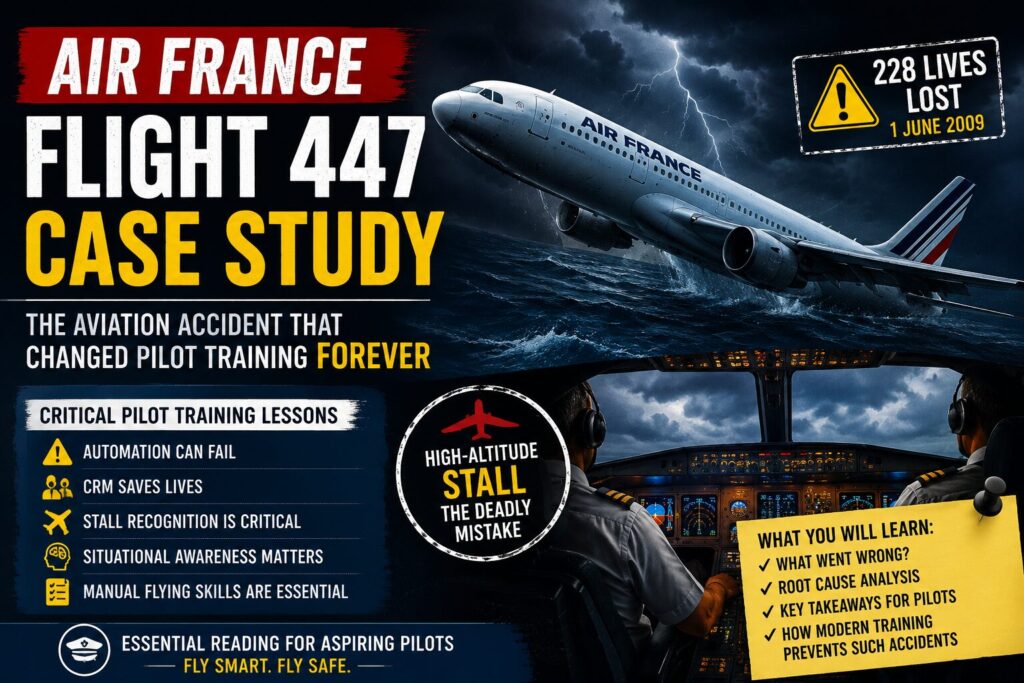
Air France Flight 447 Case Study: Critical Errors That Changed Pilot Training Forever
Direct Answer:
The Air France Flight 447 accident occurred on 1 June 2009 when an Airbus A330 entered a high-altitude aerodynamic stall over the Atlantic Ocean after unreliable airspeed indications caused the autopilot to disconnect. The crew failed to recognize and recover from the stall, resulting in the loss of all 228 people onboard.
Today, the Air France Flight 447 Case Study remains one of the most important pilot training lessons in aviation because it exposed weaknesses in manual flying skills, automation dependency, stall recognition, and Crew Resource Management (CRM).
Table of Contents
- What Happened During Air France Flight 447?
- Why Is This Accident Important for Pilot Training?
- What Were the Main Causes of the Crash?
- How Did Pilot Decision-Making Affect the Outcome?
- What Is a High-Altitude Stall?
- What Pilot Training Lessons Came From AF447?
- How to Become a Pilot in India?
- Eligibility Criteria
- Step-by-Step Process
- Cost Breakdown
- CPL vs Cadet Program
- Career Opportunities & Salary
- Common Mistakes to Avoid
- FAQs
What Happened During Air France Flight 447?
Direct Answer:
Air France Flight 447 crashed into the Atlantic Ocean after entering an aerodynamic stall at 35,000 feet. The stall occurred after the aircraft's pitot tubes became temporarily blocked by ice crystals, causing unreliable airspeed indications and autopilot disconnection.
Key Facts
| Item | Details |
|---|---|
| Aircraft | Airbus A330-203 |
| Date | 1 June 2009 |
| Route | Rio de Janeiro – Paris |
| Fatalities | 228 |
| Flight Phase | Cruise |
| Location | Atlantic Ocean |
Sequence of Events
- Aircraft cruising normally at FL350.
- Pitot tubes became temporarily obstructed by ice crystals.
- Airspeed indications became unreliable.
- Autopilot disconnected automatically.
- Pilot Flying applied excessive nose-up inputs.
- Aircraft entered an aerodynamic stall.
- Crew failed to identify the stall.
- Aircraft remained stalled for almost four minutes.
- Aircraft impacted the Atlantic Ocean.
Why Is This Accident Important for Pilot Training?
Direct Answer:
This accident fundamentally changed airline pilot training worldwide. It demonstrated that pilots must maintain strong manual flying skills even in highly automated aircraft.
Key Training Lessons
- Automation can fail unexpectedly.
- Manual flying skills remain critical.
- CRM can prevent accidents.
- Situational awareness is essential.
- Stall recognition must be immediate.
- Decision-making under stress requires training.
Today, DGCA-approved training organizations and airline cadet programs include upset recovery and manual flying exercises inspired by lessons learned from AF447.
What Were the Main Causes of the Crash?
Direct Answer:
The crash resulted from a combination of technical issues, human factors, automation dependency, and failure to recognize a high-altitude stall.
Technical Factors
- Pitot tube icing.
- Temporary loss of reliable airspeed information.
- Autopilot disconnection.
Human Factors
- Startle effect.
- Loss of situational awareness.
- Poor communication.
- Inappropriate control inputs.
Training Factors
- Limited high-altitude stall exposure.
- Insufficient manual flying practice.
- Overreliance on automation.
How Did Pilot Decision-Making Affect the Outcome?
Direct Answer:
Pilot decision-making played a significant role. After autopilot disconnection, incorrect control inputs caused the aircraft to enter a stall and remain stalled until impact.
CRM Failures
- Unclear communication.
- Lack of role clarity.
- Conflicting sidestick inputs.
- Failure to diagnose the actual problem.
Today, AF447 is studied extensively during CRM and airline simulator training worldwide.
What Is a High-Altitude Stall?
Direct Answer:
A high-altitude stall occurs when an aircraft exceeds its critical angle of attack at cruising altitude, causing the wing to lose lift.
Characteristics
- Reduced stall margins.
- Thin air.
- Reduced aircraft performance.
- Slower recovery.
- Greater energy management requirements.
Basic Recovery Actions
- Reduce angle of attack.
- Lower the nose.
- Apply thrust.
- Regain flying speed.
- Return to stable flight.
What Pilot Training Lessons Came From Air France Flight 447?
Direct Answer:
The accident transformed airline pilot training globally by emphasizing manual flying proficiency, upset recovery, CRM, and automation management.
Industry Changes
- Enhanced stall recovery training.
- Upset Prevention and Recovery Training (UPRT).
- Improved CRM programs.
- Greater emphasis on manual flying.
- Automation management training.
- Scenario-based simulator exercises.
How to Become a Pilot in India?
Direct Answer:
To become a pilot in India, students must complete Class 12 with Physics and Mathematics, obtain DGCA medical clearance, complete flying training, and earn a Commercial Pilot License (CPL).
Basic Pilot Career Path
- Complete Class 12 with PCM.
- Obtain DGCA Medical Certificate.
- Join CPL Ground School.
- Pass DGCA Examinations.
- Complete Flying Training.
- Build 200 Flight Hours.
- Obtain CPL.
- Apply for Airline Recruitment.
Learn more: How to Become a Commercial Pilot in India
What Are the Eligibility Criteria for Becoming a Pilot?
Direct Answer:
Students must satisfy DGCA educational, medical, and age requirements before beginning commercial pilot training.
- 10+2 with Physics and Mathematics.
- Minimum age 17 years for SPL.
- Minimum age 18 years for CPL.
- DGCA Class 1 Medical.
- English proficiency.
What Is the Step-by-Step Process to Become a Commercial Pilot?
- Complete Class 12 with PCM.
- Obtain DGCA Class 2 Medical.
- Convert to DGCA Class 1 Medical.
- Join Ground Classes.
- Pass DGCA Exams.
- Complete Flying Training.
- Clear RTR Examination.
- Complete 200 Hours.
- Apply for CPL.
- Prepare for Airline Selection.
What Is the Cost of Pilot Training in India?
Direct Answer:
The total cost of becoming a commercial pilot in India generally ranges from ₹45 lakh to ₹70 lakh.
| Training Component | Approximate Cost |
|---|---|
| Ground School | ₹1–3 Lakh |
| Flight Training | ₹40–65 Lakh |
| DGCA Exams | ₹20,000–50,000 |
| Medicals | ₹10,000–25,000 |
| RTR Training | ₹25,000–1 Lakh |
CPL vs Cadet Program: Which Is Better?
Direct Answer:
A CPL route offers greater flexibility and often lower costs, while a Cadet Program offers a structured airline-oriented pathway.
| Feature | CPL Route | Cadet Program |
|---|---|---|
| Cost | Lower | Higher |
| Flexibility | High | Limited |
| Airline Tie-Up | No | Usually Yes |
| Recruitment Support | Variable | Strong |
Related Reading: CPL vs ATPL in India
What Career Opportunities Are Available After CPL?
Direct Answer:
A CPL opens career opportunities in airlines, charter aviation, cargo operations, corporate flying, and flight instruction.
| Position | Annual Salary |
|---|---|
| Flight Instructor | ₹4–10 LPA |
| First Officer | ₹12–30 LPA |
| Senior First Officer | ₹25–45 LPA |
| Captain | ₹50 LPA+ |
What Common Mistakes Should Aspiring Pilots Avoid?
- Delaying DGCA Medicals.
- Weak DGCA exam preparation.
- Choosing schools solely based on cost.
- Ignoring airline requirements.
- Poor financial planning.
- Not developing English communication skills.
Frequently Asked Questions
Is Air France Flight 447 still used in pilot training?
Yes. It remains one of the most studied aviation accident case studies worldwide.
Can an aircraft stall at 35,000 feet?
Yes. A stall can occur at any altitude if the critical angle of attack is exceeded.
How long does it take to become a commercial pilot in India?
Most students complete CPL training within 18–24 months.
Is Physics and Mathematics compulsory for CPL?
Yes. DGCA requires Physics and Mathematics at the 10+2 level.
What is the difference between CPL and ATPL?
CPL allows commercial flying, while ATPL is the highest license required for airline command positions.
Useful Resources
- Airline Prep School (ALPS)
- Commercial Pilot License (CPL)
- Pilot Training Programs
- DGCA India
- DGCA Examination Portal
Start Your Pilot Journey With Airline Prep School (ALPS)
Understanding aviation accidents like Air France Flight 447 helps aspiring pilots develop better decision-making skills, stronger situational awareness, and a professional mindset.
If you are planning to pursue a CPL, ATPL, or Cadet Program in India, Airline Prep School (ALPS) offers structured guidance for every stage of your aviation career.
Book a FREE Counselling Session
- DGCA Medical Guidance
- CPL Training Roadmap
- Cadet Program Preparation
- Ground Classes
- Interview Preparation
- Career Planning
Mumbai Campus
B Wing 103, Rassaz Castle, Opp. Gundauli Bus Stop,
Near Western Express Highway Metro Station,
Malpa Dongri, Andheri East, Mumbai, Maharashtra 400093
Pune Campus
Second Floor, Above Ganesh Bhel,
Opp. FC College Main Gate,
Fergusson College Road, Shivajinagar,
Pune, Maharashtra 411004
Take the first step toward the cockpit today.